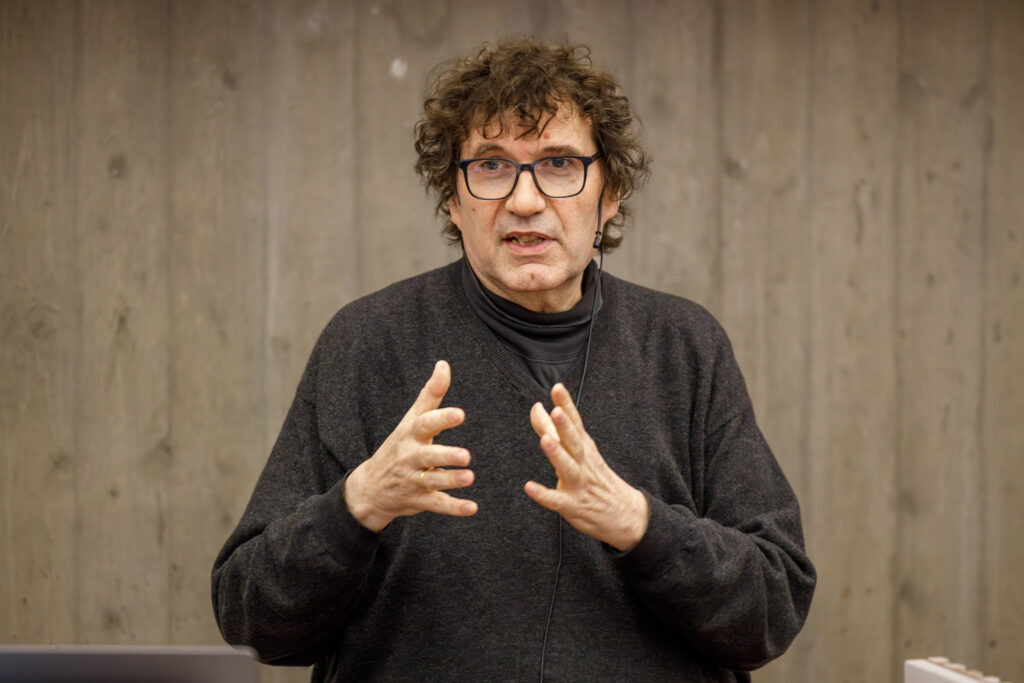
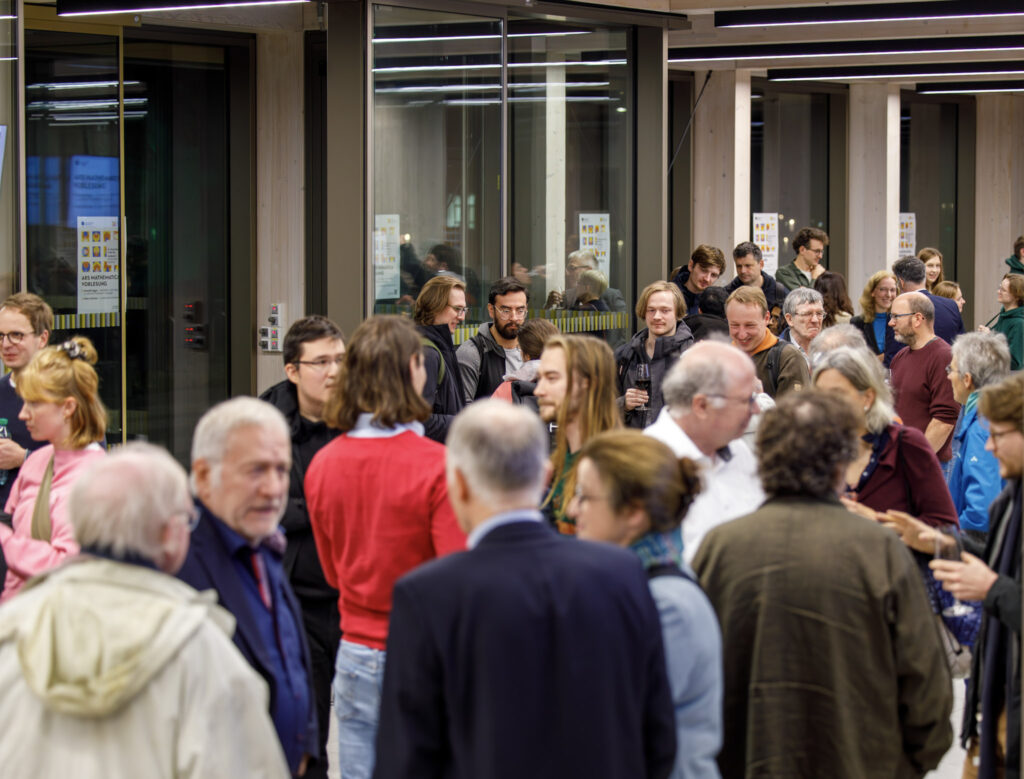
Die Auftaktveranstaltung der neuen Vorlesungsreihe Ars Mathematica an der Universität Bielefeld hat gezeigt, wie produktiv der Austausch zwischen mathematischer Forschung und literarisch-philosophischem Denken sein kann. Rund 450 Gäste hörten sich den Vortrag von Fields-Medaillen-Träger Professor Dr. Peter Scholze vor Ort an. Ab sofort ist der aufgezeichnete Vortrag online verfügbar und gibt einen allgemeinverständlichen Einblick in die verdichtete Mathematik.
Wie lässt sich das Unsichtbare sichtbar machen? In seinem Vortrag im Rahmen der neuen Reihe Ars Mathematica nimmt Fields-Medaillen-Träger Peter Scholze das Publikum mit auf eine Reise in die Welt der verdichteten Mathematik. Mit klarer Sprache und spürbarer Begeisterung zeigt er, wie abstraktes Denken neue Räume des Verstehens eröffnet und warum Mathematik manchmal tatsächlich ein bisschen Magie ist.
It’s a great honor to speak at this first hour. Ask Mathematica, and we’ll stand here.
I think I need to improve on my reading comprehension, because I think when I was initially invited, I didn’t even realize that it would have also this,
this poetry aspect to it. And I’m also, it was really interesting to listen to,
the talk before I, I that very, interesting.
Right. The other thing I wanted to say upfront is, that I’m probably speaking too fast and not clearly enough.
So if I do. So please stop me and I will try to slow down. Which is also good, because I think I have too few slides.
And so let’s wait. I talk might be way too early.
Maybe I should say that, I in my work, I basically don’t use any technology,
and I’m kind of hate technology, and I hate to give presentations.
So to the universities, please always install black first and lectures, lecture halls.
I feel like like I know I don’t have my instrument at hands, so I need to do my best, but.
Okay, let’s see how it goes. Right.
Another thing I wanted to say before I really start my talk is that, I think it does actually connect quite a bit to the previous talk we saw.
On the one hand, there was a seem of Pyrrhic numbers at work. Maybe not quite explicit, but certainly implicit in the talk.
And there were quite a few pictures, which were very similar to pictures that maybe will come up in a very similar form in my talk.
The other thing that inspired me, and maybe, I don’t know, I think the usual thing was poetry that you maybe interpret this
in things that, connect to you and maybe not in the originally intended ways.
But this idea of a world, in a world and also this world is starting very much reminded me,
of course, I’m giving lecture. Course I’m giving right now. It’s the University of Bonn
where, I mean, one of the starting points is to resolve this usual conflict
that in mathematics that already maybe can’t be realized, that you cannot have a set of all sets
and or you can I mean, usually if you want to collect all things of a certain type together, then it’s it’s a bigger thing.
So you can’t it can’t really be a part of itself. That turns out that using this language of categories.
So, for you, maybe all sets together, they shouldn’t form just a set. I should form a category. There should be maps between sets that you also remember.
And so of course it’s important to talk about categories of categories and categories of categories of categories.
And And there is actually way to have a category of categories that contains itself without a contradiction arising.
Which is a bit, surprising, I think, because I think usually mathematicians have come to believe that such a thing could not consistently exist.
And, and then all these complicated categories of categories of categories together,
there is a certain way to think about this as a geometric object. And we needed a term, for this type of geometric object.
And eventually we started for the term just started for. Right.
Was that out of the way? Let me start my talk proper,
this didn’t work. In select the other direction.
No, it starts, right. So here is a little bit of a, outline of what will happen in this, talk.
So, first I will start with a brief introduction, like, trying to set,
the scene of what’s about, to come in in some detail. Then there will be actually a somewhat long section
recalling very basic school level material about the real numbers. But for a reason, because
I think I think there’s I mean, there’s something I only understood about the real numbers a couple of years ago.
And I want to kind of try to get that point across that there is something very, very basic about the real numbers.
That one kind of often doesn’t see,
this will then bring me to the core part of this talk, which is this notion of condensed sets and how it relates
to a more classical notion in mathematics called, topological spaces.
Then I want to explain a little where this notion of condensed sets comes from.
So what’s the origin of this, which is exactly coming from these numbers?
And at the end, I want to maybe give a little bit of an idea of where one might use these ideas.
In other parts of mathematics. All right.
So, let’s start with the introduction. So, let me start
writing this mathematics around 1900. So around this time, mathematicians try to properly
set foundations for mathematics, try to summarize what they do in,
and, yeah, really have proper definitions of all the mathematical objects, they are using. And one extremely basic notion is just that notion of a real number,
which, as it turns out, is actually not as easy to define as you might think it is, because it’s a very basic notion to learn about in school.
And it’s very, very intuitive. But actually to properly define what the real number is, it takes real effort.
And as I said, I will later in the talk, expand on this point
and extremely influential in this area was Cantor’s work in particular on the notion of set.
And somehow all of mathematics was then founded on contours set theory.
But the notion of a set, a set is basically just points. But they don’t speak to each other.
They are just points. One alone, without any geometric structure to them.
But the real numbers, they have a very visible geometric structure, you can say, when points are close together.
And so there is no in the two if idea that sum of their neighborhoods of points.
And this was encapsulated in the extremely influential notion, of a topological space.
And I think this definition goes back to how story in around, 1914 actually
mentioning how stuff and being at events combining mathematics and poetry. I should also mention that house stuff was not only one of the world’s
leading mathematicians of his time, but he was also a poet. So he wrote several theater plays, several poems,
most of them under a pseudonym, I think Paul Mong Gray. Is that right? I’m, I don’t, I might say wrong.
But, this notion of a topological space is at the very foundations of mathematics, and it’s really used in all areas of mathematics.
You learned very early on in your studies, and it’s really basically used everywhere.
However, in many areas of mathematics, even in topology itself, which is some of
the area studying topological spaces, people are not quite happy with the definition of a topological space.
And so topology has they have a notion of a convenient category of topological spaces, because
the actual one is not so convenient. So there are certain persistent technical problems,
with this notion of a topological space. And, but people had kind of
come to believe that this is just an inherent property of this mismatch. The idea of a topological space.
Around 100 years later, there was some, a lot of work done in this geometry with these numbers
that I will also explain a little later in my talk and
studying these perfect, these, the sphere geometry, this is related to these perfecto spaces that, I mentioned earlier.
Gave rise to the burst of a new concept that was a few years later, given the term of condensed sets.
And my work was just enclosing, and,
this turns out to be extremely similar to this notion that’s extremely similar to topological spaces, but
with a kind of very different definition, very different perspective. So.
Virtually everywhere you do stuff, logical spaces, you might as well use condensed sets. And basically they’re more or less equivalent.
So it doesn’t really matter. But then the yet slightly different and to slight difference
means that very often all the technical problems that you have to say just magically disappear.
Which was very surprising to me. And I think to many mathematicians, that is,
that you could just, by slightly tweaking the definition, make many of these technical problems magically disappear.
And, yeah. So this gave rise to the general idea of, condensed mathematics that you could try
to apply this notion of condensed sets to various different areas of mathematics.
And I want to talk a little bit about this today, but always because it’s similar, a different definition.
It’s somewhat always introduces a shift of perspective. You’re always looking at things from a slightly different angle and certain
what seemed natural from the perspective of logical spaces may seem not so natural from condensed sets, and vice versa, but certain things
that seem not so natural from such logical spaces might seem natural from the condensed perspective.
So you get a new perspective on very basic, objects in mathematics. And so
one of them, one of the basic objects to get a new perspective on, I think, the real numbers.
And basically the goal of my talk today is to explain the condensed perspective on the real numbers.
All right. So this brings me to the second part of my talk, about trying to recall a little bit of this is for all the extremely
elementary school level material, some recollections about the real numbers.
So let’s recall a little bit about what numbers, and what how to think of them geometrically.
So maybe the first kind of numbers one learns about, the natural numbers, one, two, three, four, five and so on.
And you may or may not consider a zero as a natural number. So it’s kind of slightly blurred. The,
I mean, certainly in the history of mathematics, it took quite a while until zero was considered, to be on equal grounds.
With the others. And there’s a way to think about this, geometrically, which in particular is how, the Greeks did it,
like Euclid. So there. You fix some reference sticks, say one meter or something like this,
and then once you have this reference stick, you can start measuring things and try to measure how many meters this is.
And it’s probably slightly over two meters, but then you couldn’t quite measure it with a meter. What the rest of this is.
So if you just have one reference stick, then you can try to measure it along,
along a line. Yeah. You can measure some, integral distances,
from, from the origin. Of course, you could also go to the left,
leading to some of those, the integers, well, okay. It’s by infinite,
and some of the next class of numbers one learns about in school, the rational numbers, like three half, nine, seven, and so on.
How to think of those geometrically? Well, I could just make dots there where the where they are.
But maybe this is not quite, how the Greeks thought about this. So let me explain. Or actually.
And in Euclid, you think about, about the rational numbers.
You could just start with, something that actually
goes, comes back to this idea of reference sticks. So somebody say I have a meter, but then I go to England and they measure everything in foot.
So then we have suddenly two reference sticks and we need to somehow translate between our measurements.
So it’s a very practical problem to translate measurements between people using the different reference sticks.
And so to do that. So yeah, would someone like to know how to do the translation and
the idea is that Euclid’s uses that nowadays might be called Euclid’s algorithm is the following.
So assume you have two sticks. Then if I know I was a shorter stick, I can first measure with my one meter
six inches, maybe slightly more than a meter, and then I could try to use my my other stick and then try to some measure is this, but I can also
use one of my sticks to try to measure the other. And so if I have my my queen stick here, but slightly more than two red
sticks, button, if I have both of these as measurement devices. And I can also measure this flexing here, which is a remainder.
So I can somehow write the green stick as two times the red stick. And then I can make a new black stick, which is precise is a reminder that,
that you have there. And then I can then I have two smaller sticks. So now I made the red stick and the black stick stick.
And I can try to do the same and try to measure the red stick in terms of the black stick. And if I’m fortunate, then at some point this will precisely close up.
So and so and so this case, I try to draw something where this basically, ends up working.
And so where the red stick is precisely twice a times the black stick. And so then I can use a black stick as a common reference
measure using which I can translate it. Those other measurements in terms of the, the black one, namely
the red one is just twice the black one and the green one. And then we places where once but twice like once.
This is for totally five times the black one. So, out of the two, green and red, you can build a new one,
a smaller one, which is the black one, and then the others are just multiples of this common reference one and
this is basically how the Greeks thought about the rational numbers 2/5. That means the red stick is about 2/5 of the green stick,
meaning that you can find the smallest stick of which one is twice, the red one is twice it, and the green one is five times it.
But they also knew that you won’t always be lucky. This does not always work.
And of course, the example here, comes from the physical, serum.
So if you have an equilateral triangle over side lengths A, B, and C, then the famous theorem of Protagoras.
So I said x squared plus p squared is equal to c squared. And fortunately enough it turns out that you can find integers satisfying this.
For example three, four and five, which is very practical because it gives you a way to construct precise vector, rectangles, because you can just
two, three times your stick, four times your stick, and then five times you stick and then arrange that and you have a precise rectangle, which is,
I think, how they even constructed precise rectangles back in the day.
But if you do the same thing for a much more naive, rectangle which has both sides, line one
then the other side will have a new side length, which we nowadays call the square root of two.
And now you can try to run this algorithm, I talked about before. So trying to measure,
the red stick in terms of the green stick and then. Well, it fits the green stick fits one times in, and then there’s a remainder which somehow has the length square root of two minus one.
And then you take your green stick. And then while this flex stick turns out to fit twice in,
and then there is a remainder that maybe you can see, but it should be in blue.
And then there is, no. Yes. The black and the blue take in the blue stick.
And you can try to measure the black in terms of the blue, but that again, there is a remainder. And you could keep repeating and you would realize
that at every step, some are two times the previous one fits in. But then there is a little remainder.
And this kind of repeats itself. So it turns out that the ratio between the screen and the blue one
is exactly the same ratio as the black and the remainder here. And if I would extend the previous one also to the left
and by adding another green stick, then it turns out that this composite thing would also be precisely. It’s the same ratio to this as this has to this.
So the ratio of green plus red to black is the same as the green to the blue
is the same as a black to what remains here. And so just this pattern repeats itself indefinitely.
And so this algorithm will just never stop.
If you think about what this means, it actually gives you some kind of iterative formula for what is the square root of two is.
Namely, if you’re trying to construct two sticks which have a ratio square root of two, then you could say, well, okay, maybe this is really small.
Let’s just forget about this. Pretend this was exactly twice times this, and then you could somehow have this, take this twice, this twice, and so on and iteratively construct,
the thing which in this is this, continued fraction expansion, actually,
that is one plus one over two plus one over two plus one over two, giving you a very precise infinite formula for the square root of two is.
And, you can just cut off this at some point or here or here.
So for example, if I, I mean, if I cut it off immediately, just good one. If I cut it off here I will get three halves. If I cut it off here I get seven over five.
And you see that you get closer and closer and actually really rapidly you get closer to the square root of two. So this is one which is a very pretty bad approximation.
So this is 1.5 to 1.4. I don’t know exactly what this is, but
you get very, very close to, to the square root of two very quickly.
Okay. So the square root of two is not a rational number. This is, I think, how the Greeks proved that.
So nowadays, what usually explains a different proof of this. But I think this very geometric argument is, how the Greeks thought about it.
All right. So back to my, table comparing numbers and geometry.
So we have these rational numbers. Now we have some way of thinking about some, so we can fill them in into this line.
Yeah. But then we see some of that. Not all the points are covered precisely because there are these other numbers, like a square root of two
that some of sits somewhere also on this line, but is not a rational number. And so realize that if we
really have this geometric picture in mind that there is this full number line,
then there must be more there. And the whole thing is what we think of as real numbers.
And this is supposed to be the definition, but obviously it’s not a mathematical definition because it definition
appeals to our geometric picture of this number line. And it turns out that it’s actually not so easy,
to make this into a precise, must make definition. What you learn in school usually is that the real number
is given by its decimal expansion. So in particular, like there is a way
to write the square root of two in terms of some like infinitesimal expansion. I think the first few terms of what I wrote, I hope
but then goes on and on and on. I mean, it’s not nearly as nice as the previous formula. I find this is one plus one over two plus one over two,
which is where you see an infinite pattern emerging. So digits here are just some random digits without any pattern to them
as far as anybody knows. And everybody is sure that there won’t be a pattern there.
Now, what does this kind of mean geometrically is this infinitesimal expansion. Well, the first one here precisely means that
here are some larger than one, but smaller than two. So they’re somewhere on this interval. Okay. So let’s zoom in on this interval.
Let’s make it larger. So zoom in. This is now the interval from 1 to 2. And now we can again space it into ten pieces.
Some of picking a reference takes at precisely one tenth of the length of my original reference stick.
And then the next digit four. So means that I’m precisely on this interval here. Okay. So then I can zoom in again, and then I have this interval from 1.4 to 1.5 here.
Then the next one means that I’m somewhere here in this interval and so on and so forth. So someone zooming in and zooming in and zooming in,
and determining more and more precisely where you are, where your numbers.
But actually. So you might think that this way
we uniquely prescribe any point of the real number line, because we have precise precisely at each step prescribing on which of these intervals we are.
But actually that’s not what we’re doing. If we look carefully,
if using the first digit no decimal expansion, we’re saying on which of these intervals we lie.
Right. So it’s the first digit is zero is here. If so first, which is one over here, and so on and so forth.
And then the next due to some, decomposes it further.
But when we are precisely at for, say, well, I mean, there’s actually two intervals we might be on,
we might be on this interval or we might be on this interval. And we need to we need to make a choice there,
which interval we actually mean. So that’s like if you are given a decimal expansion, you
cannot only produce a point of this space, which is what we wanted. But given a decimal expansion, you can also,
determine the point of this disjoint union here, or really in this space
where you divided it even further or even further. So a decimal expansion really determines a point
not just of the real number line, but of an infinitely dissected real number line where you cut your all of the line into this,
unit intervals, and then each unit interval into tens of unit intervals. And the distance of units will travel further and further.
So what decimal expansions really describe is not a real number line, but a certain infinity section of it.
And to get back to the real number line, we need to glue everything back together.
We had these two intervals here. But we kind of cut we cut the real number line at four
to get this part and this part, and to get the real number line back, we need to glue this point to this point.
And what does this mean in terms of, the formulas? Well, what is this point in terms of decimal expansions?
Well, it’s on this interval which we need to start with a four. But then afterwards I always need to stay on the leftmost part.
So I always need to put 0000. I’m always after this I’m always staying on the leftmost part.
And what is this point here. Well this is on the interval that starts with a three. So it’s somehow this thing that starts with a three here.
But then I always want to stay at the rightmost point. So then I always need to fix the last interval meaning always A9999999.
But in the real number line these were really the same thing. So I need to set them equal in the real numbers.
And I think at this point that’s really confusing when you’re trying to define real numbers in terms of decimal exchange, because you don’t see why these two numbers should be equal.
And then usually they’re algebraic manipulations given that are supposed to explain why this is the case.
But I think that’s just a really geometric argument that they must be the same is that decimal expansions don’t themselves describes the real numbers.
I describe this infinitely. The second thing that you need to do is spec together, which are precisely these weird identifications.
And so the perspective you’re getting this way on the real numbers is that’s the number line
of the real numbers, which we really think of as a continuum,
arises in a very weird way out of a completely insensitive sector, totally disconnected space.
What we dissected this instance, I often, and these things are described by decimal expansions,
but then we need to glue things back together, which are precisely these identifications here. And this is what only gives us a continuum.
Okay. So this was my,
digression on real numbers. So, so and this somehow gives the lead, to this discussion,
of the difference between this notion of topological spaces and condensates. And my discussion will not be technical at all.
It will be an extremely informal level. So I apologize to all mathematicians in the room.
So, so what is this notion of topological space?
As I said earlier, it’s formalize the idea that you have a set and you have some certain notion, of, of neighborhoods.
So, yeah, I was drawing the real number line. You have any, any point X on the real number line.
And then you always have these small neighborhoods of this point. And these small neighborhoods are still nice,
nice spaces in or if you have a more complicated space, like, like this cake,
then the way you would somehow try to analyze this is you really look at the finished product and pick out small neighborhoods of a point.
I like take taking a spoon and like looking at what what you’re getting and then analyzing these, these small neighborhoods.
So some of the logical perspective on a mathematical object is that there is this finished product, and you’re
trying to analyze it by looking at how it looks like near any given point.
Okay.
Let me contrast that with this notion of a condensed set, for which, again, I will only give an extremely informal discussion.
So the way to think about a condensed set is that it’s a baking recipe for how to build your desired object
out of totally disconnected pieces. And we’ve precisely seen such a way, in the case of the real numbers,
where we had the totally disconnected piece, which were algebraically given by these decimal expansions, and which form to feel like intuitively some kind of point, cloud or mismatch
in the statistics call such a thing a counter set. Which is a bit unfortunate because earlier set
the counter just defined abstract sets. But now there’s also a specific thing called the counter set, which has some kind of topology on it.
Sorry. But yeah, yes, it’s totally disconnected thing.
And then by doing these identifications, I told you that of identifying the endpoints of these intervals and also of these internal intervals,
you’re gluing this all together somehow, and then in the end, you’re making the continuum out of totally disconnected pieces in a way
which is maybe not. So, similar to how you bake a cake out of, like, flour and sugar and other very disconnected pieces.
And then you put them in the oven and then it becomes a nice continuum.
Okay.
So what’s the advantage of this condensed perspective? The main advantage, maybe for me, I’m a knowledgebase.
The numbers theorist at heart. Is that as these totally disconnected pieces,
they are extremely simple to describe algebraically. So one way,
that mathematicians used to do this is in terms of something called stone duality, describing them in terms of p and algebras.
But really it’s just what you’ve seen before. If you try to use algebra to describe stuff, something like decimal expansions,
this is algebra will always describe a totally disconnected space. You will not be able to directly with the algebra, describe a continuum.
So yeah. So some of these just totally disconnected spaces. These are the ones which have a simple algebraic description.
And this is at the heart of why these condensed sets turn out to interact extremely well with all sorts of algebra.
And so this is also where they’ve maybe found the most applications, so far in doing some kind of very nice algebra with condensed sets condensed to be in groups
and so on and so forth. But from a geometers perspective,
it’s extremely unnatural to think of the real numbers as a function of a totally disconnected space, because all the nice geometry of the
real numbers, all this nice continuum structure, is completely obliterated if you just infinitely dissect your space on and on and on. So,
from a geometric or maybe also analytic perspective, it’s not so clear that this condensed perspective
is good at all. And maybe I want to come back
to this question towards the end of my talk, but this is, I like very from very, very far away,
how you should think of a condensed set. It’s some kind of recipe for building nice spaces out of pieces that are somehow geometrically not so nice.
They are totally disconnected, but have a nice algebraic description.
Let me tell you how this weird idea originated.
This comes from, theoretic geometry. So the P here stands for a prime number.
That could be any one you like. My favorite is two.
But you could also take three, 5 or 7 or whatever. Actually, anecdote, was once,
giving a course on algebraic geometry and at one point I had to draw a space called spec Z where the points are the prime numbers.
And I was drawing 235, seven nine.
So I’m not so good with numbers.
And also now I’m doing ten adic numbers, and you’ve also realized that maybe ten is also not a prime.
It turns out that the basic structure of theoretic numbers works for any natural number, and you could have any adic numbers.
There is a certain reason that usually restricted prime numbers, because
then it’s a field. Otherwise it’s not a field, and it’s two numbers which are not zero, and that multiply to zero. And maybe you don’t want that.
But if I would have to introduce numbers, I should first
switch from the familiar decimal expanses of numbers to chaotic expansions for some other prime P, and this is just a further layer
of technical complexity that’s somewhat irrelevant to the story. So let me not do it and instead talk about, ten adic numbers directly.
And so one way to think about them is that they’re really just just like decimal expansion of real numbers.
But instead of going infinitely far to the right, you can think too far to the left. Now, this doesn’t seem to have any geometric meaning whatsoever.
It’s hard to think about what such a number should signify at first, but you can easily convince yourself that you can.
It’s very easy to do algebra with them, right? I mean, if you have such a number and I want to add this number to it, then I can just I mean, three is one and seven plus four is one.
And then I carry a one and then one person and and I don’t know and to whom you can figure it out.
It’s even easier than the real numbers because in the real numbers, if I start from the left and go to the right,
I don’t know what I would have had a carry from the right coming up. So somehow if I want to get a specific digit in the real numbers, I would
sometimes need to go infinitely far to the right to figure out whether there was a carry coming up forward to me.
And the numbers, you don’t have to do that. You can just start from the right, and you always know whether there’s a carry or not.
You can also do some funny computations, like if you take the infinite string of nines and just add one to it, then nine plus one is ten.
So it’s a zero and the number, but I carry one and the nine plus one is ten. So it’s zero and the carry one.
So 9999999 is equal to minus one into ten numbers,
which seems a bit surprising, but it’s true. So basically if you, you know, I don’t know, like,
I mean, it’s very familiar that if you have like one and then lots of zeros and ones and you get lots of nine spots and eventually something drops.
But here you can always borrow more and.
So these weird numbers, they originated the number series. And what they’re really meaning is the following.
If you’re somehow only remembering the last digit of an integer, then you’re only remembering the remainder when you divide by ten.
So everything that this is. So it’s like if you have 372 things
and you want to distribute among ten people, then you can do it evenly. Except there’s 320. You can do evenly, but the last 70 would be the remainder.
So if you’re only interested in not in the precise natural numbers, but only in the remainder modulo ten or modulo 101,000.
Then this is precisely kept track of in these numbers on these ten adic numbers in this case.
So they can be thought of as a way of keeping track of these, these remainders modulo,
division under all powers of ten.
No, it’s that precisely because you cannot always like this issue is carrying doesn’t come up.
You actually do not need to make any of these weird identification like .9999999 is 1.0000.
So the ten numbers are literally what’s the digital expansions?
They’re the same thing. You don’t need to do any extra identification. So the numbers they do form something totally disconnected.
So if I try to draw all this like ten of integers, then here are all the ones that end with a zero.
Here. All the ones that end with a one here, all the ones that end with a two, and so on. And and
I don’t need to do any at the intensification here because really, how does it end with a zero or end with a one and no identifications
and, if I was drawing the square of numbers instead, then one way to visualize this is very much in terms of this, circle.
And then there were three circles inside, and then each of these three circles. Yeah. Three circles again. Not all tigers talk.
So this was this picture of these circles. Inside circles is one way to visualize what the three adic numbers
would look like. And you see that if you work with these theoretic numbers,
then it’s actually a very natural idea to try to base everything on these totally disconnected sets, because after all,
that’s kind of what you’re what you’re geometry is. So content sets, I turn out to be very convenient.
And theory geometry engine and analysis.
I think I will end too early, but, it didn’t stop me, so,
the output. So, I was saying that,
some of the content sets, they are extremely natural from the perspective of the numbers geometry.
But from the perspective, the real numbers, they somehow feel less natural precisely because it doesn’t feel so natural
to take the real numbers and essentially dissect them. And in particular,
it was not so clear what is a condensed perspective. Could be fruitfully applied
in particular to analysis of real numbers. So an analysis of the real numbers is very much
built on these notions of panel spaces for safe spaces and so on. So there’s also a function analysis of these big,
topological vector spaces. There’s a huge edifices of structures there. And,
but this all feels a little bit unnatural from the condensed point of view.
So from the condensed point of view you would like to do this slightly differently.
And then thus in closed and I, we had some kind of idea of what the natural expectation would be for how you should do things.
And we tried to prove this, and then we realized it’s wrong.
I will explain the basic reason it is wrong on the next slide.
So it turns out that usually, the basic does a lot someone has about topological vector space of the real
numbers is a condition condition called locally convex, whatever this means. So basically if, if, if two things are small,
then if you draw a straight line between two small things, everything on the line should still be small.
Or if you just have any, any set of small things, then if you form the convex hull of all these small things,
everything in the convex hull should still be small.
But it turns out that, if you restrict to this locally convex setting in the condensed world,
this is not a good condition that it violates certain things we would really like to have.
And so this, was quite a.
I know I was very frustrated when I realized that this does not work.
And then we kind of tried to, like, make a deal with the devil and like, just said, well, maybe not locally convex, but just just a tiny bit less than that.
And then maybe it still works. And then, like, the obstructions that we had wasn’t there anymore,
but we still couldn’t prove it. And we tried like
I spent basically a full year obsessed with trying to make this work.
So we tried really hard, to find a proof of the slightly weaken statement without ever
being sure that it should be true, because the original hope was wrong. And then we just.
Well, if X is wrong, then maybe x minus epsilon is still true. Let’s hope for the best, but without any good reason to hope so.
And trying to prove it, we were get into all sorts of really strange considerations where
we tried to prove the thing about the real numbers by trying to prove a thing of arithmetic origin instead,
where we had some kind of power series with integer coefficients instead,
it all felt really real strange. And at the end we found an argument that.
It was extremely complicated because it involved really, really difficult algebra
combined with really difficult analysis and just barely chained together. This was a really, really fragile argument.
But we could prove that this. If our original hope was wrong, then the original hope minus epsilon is still true.
And this is the theorem. I mean, there,
but, I was so unsure about my own argument that someone asked for a formal verification of this proof,
and this was this liquid tensor experiment that I mentioned. And so,
in a very reasonable time frame, several mathematicians led by one commonly in particular, were able to, fully formalize the key
statement, in particular, the thing where where there’s a very, very fragile
combination of difficult analysis and difficult algebra, in a, in a formal proof assistant.
So now I’m reasonably confident this is actually true.
But as I said, taking this condensed perspective on, like, real function losses, your changes changes how you look at things.
And in particular, one thing, one new thing that’s really convenient for doing algebra is that you can always form so-called quotient spaces.
So quotient spaces are spaces, where you somehow identify any two points in here which lie,
whose difference lies in the image of this guy. So this is a little bit like remainders modulo ten you identity.
That’s the integers via multiplication by ten into itself. And then the quotient integers
mod ten. So it’s a nice quotient space.
But so two spaces at like the most nice, the nicest kinds of topological vector
spaces, you might maybe think about, these LP spaces, of sequences. So here you just have sequences of real numbers, who
which are Somerville. So the norm of the absolute values, is stays with you, some of them all up. It’s still finite.
So in particular can form the sum of all the exes and still get a real number. On the other end, you could ask a slightly weaker condition,
just as the sum of the squares stays finite. It turns out that whenever the sum is finite,
the sum of the squares is finite too. But not conversely. And an example of this is a sequence one half a third, of course,
where one learns that if you’re trying to sum them all up, you get what’s called the harmonic series, and this diverges to infinity.
But if you take these squares, then it does turn out that it converges. So it’s actually related to the zeta function
that also was mentioned in the last talk by Euler. You get pi squared over six if you sum was a square.
So you get something finite. So this is a strictly larger space. But but this extends image.
So whenever you have any sequence in here then you might just then the point that’s very very close is if you keep the first 100 terms
and then set everything else to zero, that certainly is Somerville because you just a finely made term.
So it’s Somerville and you can any point in here can be arbitrarily well approximated by, by all points in here.
And so if you think topologically, then if you try to form the quotient space of L2 by L1,
then this has no interesting topological structure. Because if you take any point in the space and then look at any possible
neighborhoods, and the neighborhood will be everything because,
yeah, I mean, any two points are some arbitrary well approximated by something in here.
So if you subtract that and you can make a difference arbitrarily small. So as a topological vector space is just has no interesting structure at all.
But it turns out that in condensed vector spaces this just has a perfectly well-defined content structure.
Basically I told you the baking recipe. I told you what L2 of N is. I told you what they are one of innocence.
And the recipe to bake is is just to take the quotient.
It is a well-defined recipe and you can work with it.
But if you have such weird quotients and you suddenly also get do you have new objects, but you also suddenly get new surprising maps.
For example, there is the following funny map. You can take,
again, these L1 sequences, so some sequences of real numbers. And now I’m defining a map to this weird quotient space.
Okay. And what I’m doing in every quadrant, I’m doing something that I shouldn’t be allowed to do when I do vector spaces.
So vector space is supposed to have some additions that everything all the maps are supposed to be linear. But now I’m doing this very weird thing of multiplying x by the logarithm of the
value of x. So this is a very much a non-linear map.
Okay. But you can still write it down. And this is always turns out it’s this always defines a sequence in here.
But I’m somehow only considering it up to some of the sequences. And if I, if I wouldn’t do this up to some of these sequences,
and this absolutely would not be an additive map, just because some of x times log X is not additive.
But it turns out that up to some of those sequences it is an additive map.
So if I take two sequences and as I first apply this finding x log x or a first sum, then and then apply this nef, then
the difference between these is it turns out always. So. So this is a additive method.
It’s linear under multiplication by real numbers. It is a map of condensed vector spaces.
So this is a map in this new category that’s somewhat continuous.
Additive. So it’s some of maps that I don’t think you could see in any formalism before.
This kind of map x times log X is actually very much related to the entropy function defined by and by Shannon, which is exactly the sum of the x I log x nine.
So it has some kind of mathematical meaning. I think, and.
Now this is a phenomenon that only exists in the condensed world, but we can use it to recover phenomenon known in the classical world
of topological spaces. And now here I’m really using a little bit of, more fancy algebra.
So maybe this is, not for everyone now, but, so you have this map from L1 to this quotient space.
Which was precisely the quotient of L2 by L1, which is what this kind of sequence is, signifies.
And you can take, the pullback for exact sequence. You take this thing. So ejecting onto here.
So this this will be elements in here and elements in here which map to the same element in Q. And then it turns out
that this will always produce now an extension of this guy by the same, subspace here. So you get an extension of the banner space of one by another banner space L1.
And now what’s so weird about this map that some of the not that maps inside of here means that this guy here is now a little bit of a strange topological space.
Namely, it is not any more locally convex topological space. It’s not a banner space anymore.
So we somehow started with the most the nicest kinds of topological space. This one has span of spaces and just played around a little bit with them.
And then condensed World. We suddenly could cook up a new kind of topological vector space, which falls out of the category of final spaces.
And the existence of this is what meant that our original hope was wrong.
So this, this e basically goes back to the work of Riba from 1980.
So it was known in functional losses that you can have these things and this,
this meant that our original hope wasn’t quite true, but somehow it’s not too far from being locally convex.
And so then we kind of hoped that if it slightly weakened our condition, it still works. And it did work, but
the argument is really, really difficult because real functional analysis just becomes much, much harder outside of the locally convex setting.
Many of the basic tools used in real functional analysis just completely break down those outside of the local convexity.
But the possibility now that we can apply
successfully applies a condensed formalism to real functional analysis turns out to be exactly what was needed in order to import
a lot of the lot of tools that exist in this kind of more algebraic kind of mathematics, in particular on algebraic geometry, and move them over,
to, to geometry and analysis. It was a real numbers. And one thing in particular you can do is you can,
combine, tools that have been now successfully developed some, fabrications,
algebraic geometry in particular, also higher category theory. But you can now marry this with techniques on functional analysis.
And usually these two. So this is something extremely algebraic. This is something really analytic. And the algebraic analytic world usually don’t mix so well.
But in this framework they do. And it’s just one possible outlook where such a thing might be useful
mean I think physicists sometimes for quantum field theory need something like this because they’re some people studying quantum field theory.
Really from a very analytic perspective, I’m just really nontrivial analysis going on there. On the other hand, algebraic topology, to realize that quantum field
theories are also extremely closely related to higher categories. But it’s really hard to mix these two aspects of quantum field theories.
I believe that, in the condensed formalism, it is actually quite easy.
And, so condensed mathematics might have applications in condensed matter.
All right. So that’s the end.
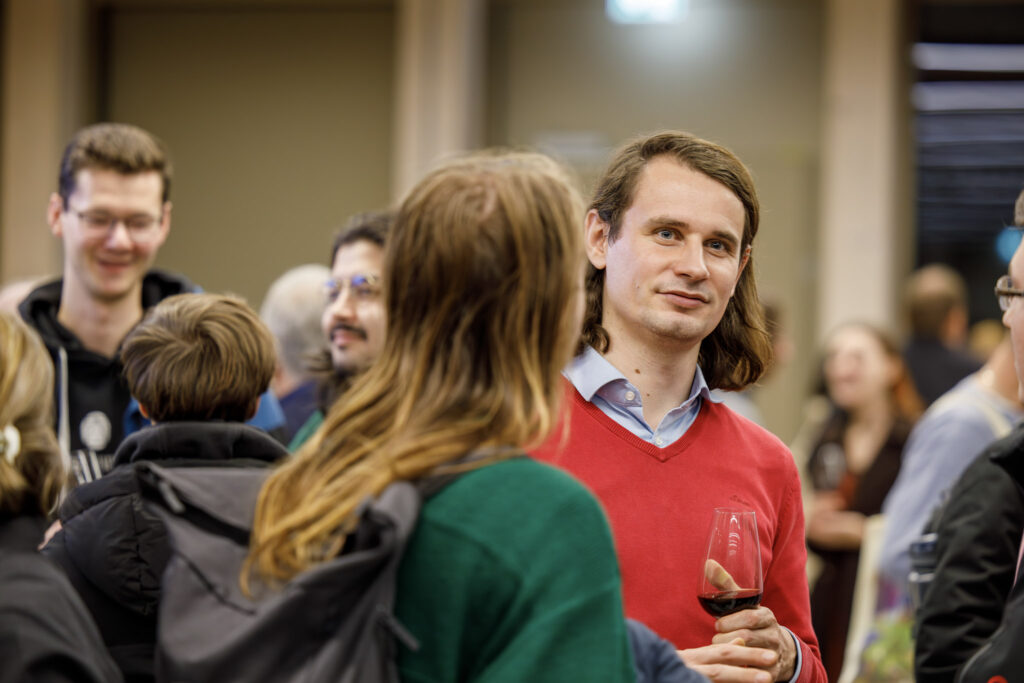
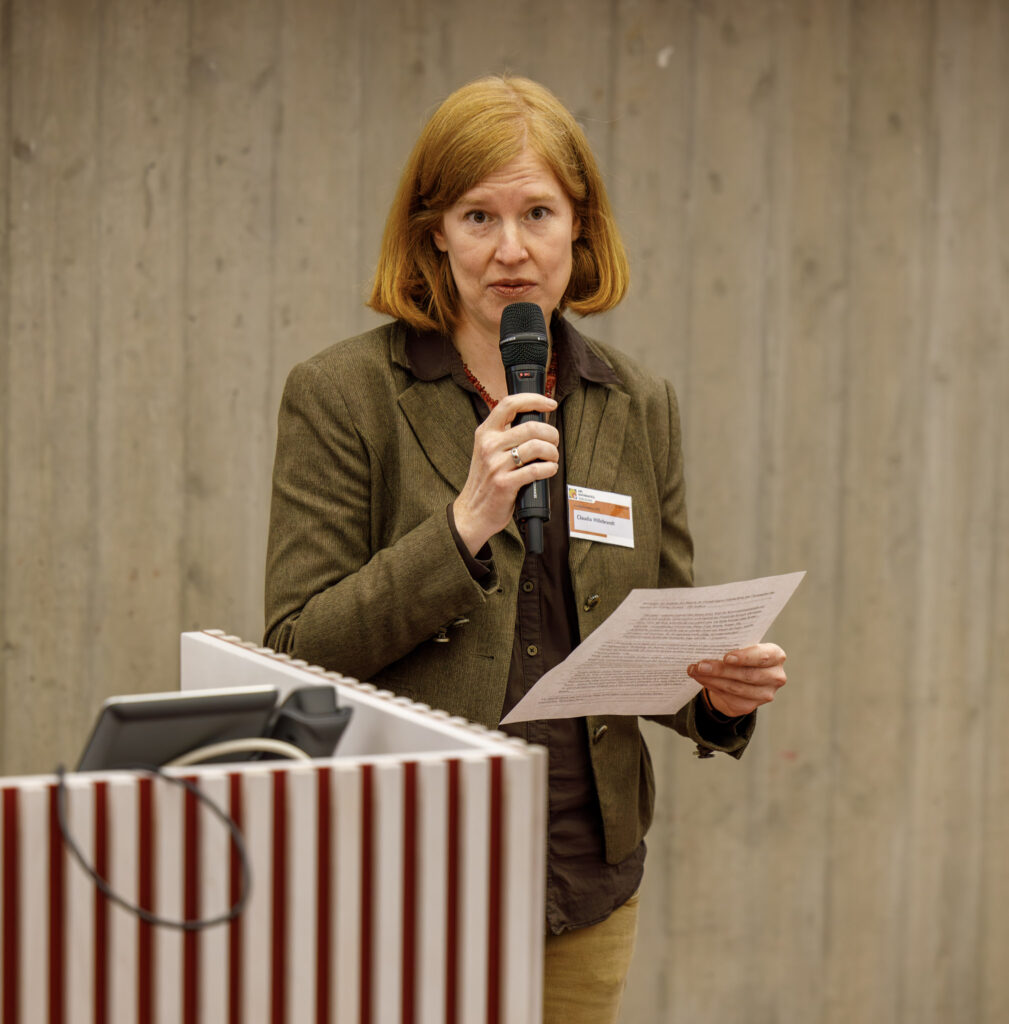
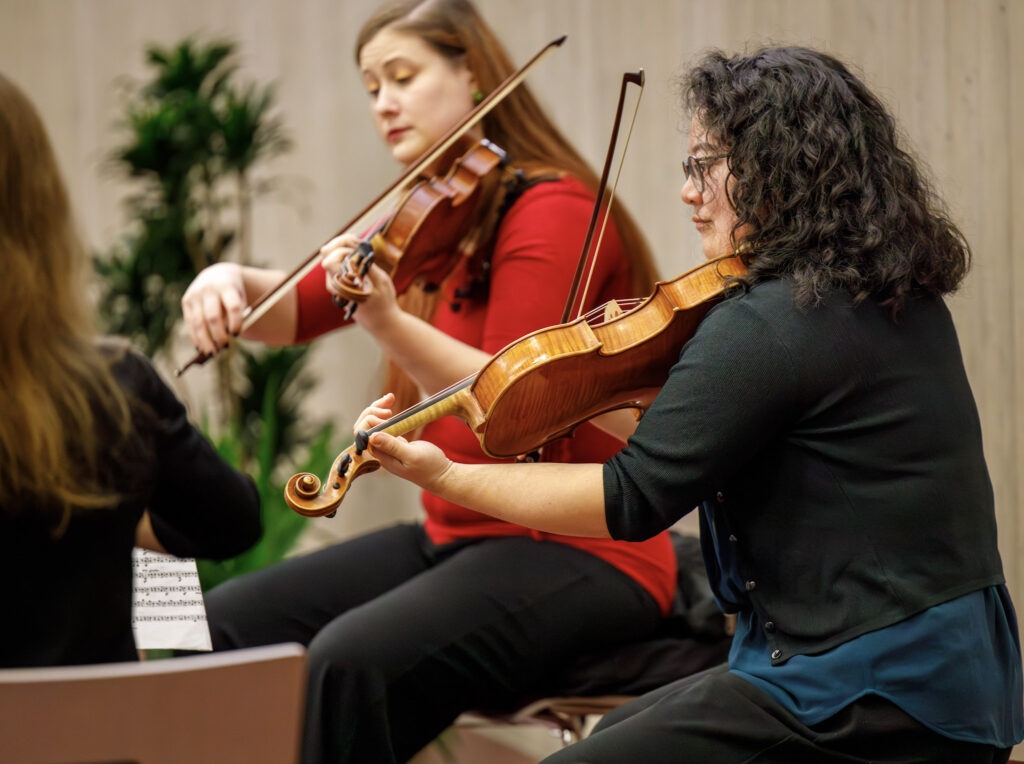
Die Anwesenden erlebten den Auftakt der Ars Mathematica mit Vorträgen von Peter Scholze und Oswald Egger. Beide Beiträge fanden außergewöhnlich positive Resonanz und zeigten die kreative Kraft zwischen Mathematik und Sprache. „Wir möchten Mathematik als lebendige, schöpferische Disziplin zeigen, die Denken und Wahrnehmen verändert“, sagt Professor Dr. Henning Krause, Mitorganisator der Reihe. „Die Ars Mathematica soll Forschung aus dem Elfenbeinturm holen und in einen Dialog mit der Gesellschaft bringen.“ Beide Vortragenden erkunden auf ihre Weise die Grenzen zwischen Denken und Gestalten, Wissenschaft und Sprache.
© Thorsten Hüls

© Thorsten Hüls

© Thorsten Hüls

© Thorsten Hüls
© Thorsten Hüls
© Thorsten Hüls
© Thorsten Hüls

© Thorsten Hüls

© Thorsten Hüls
© Thorsten Hüls
Mit der Ars Mathematica entsteht an der Universität Bielefeld ein Forum, das Wissenschaft und Kunst in einen offenen Austausch bringt.
Ars Mathematica an der Universität Bielefeld

Die Fakultät für Mathematik veranstal-
tet jährlich in festlichem Rahmen die
Ars-Mathematica-Vorlesung. Ein Ziel der
Vorlesung ist es, aktuelle mathematische
Forschung einer breiten Öffentlichkeit
vorzustellen und auf diese Weise für Ma-
thematik zu werben. Die Vorlesung be-
steht aus einem Festvortrag sowie aus
einem ergänzenden allgemeinverständ-
lichen Vortrag, der Bezügen zwischen
Mathematik und den Künsten, der ma-
thematischen Anschauung, oder auch
einem historischen Thema gewidmet ist.