
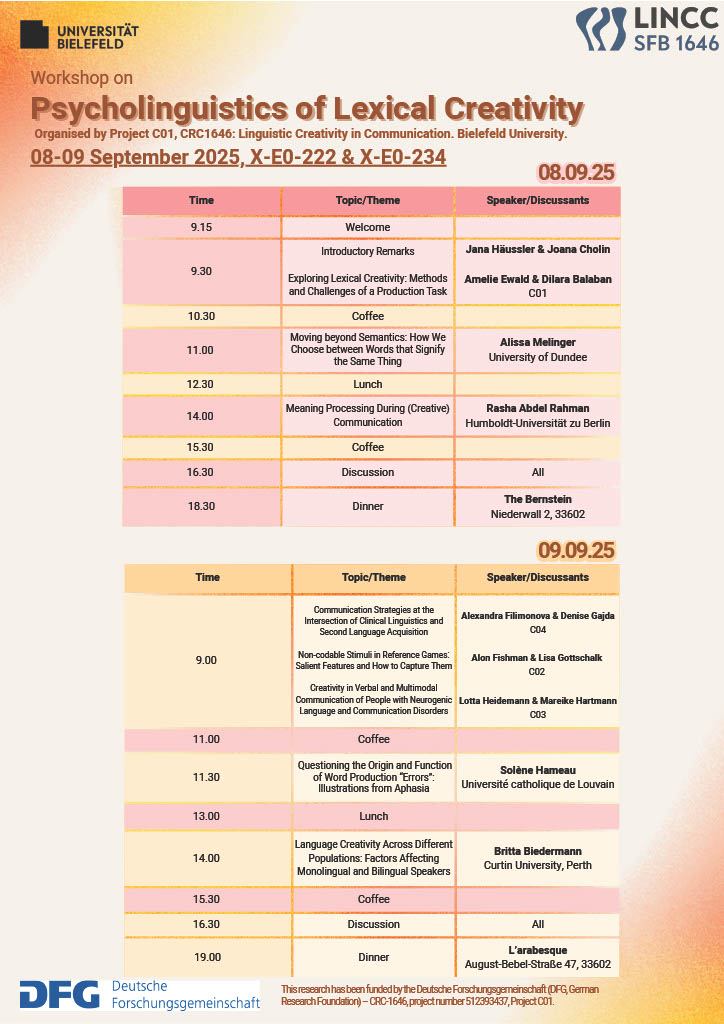
Speakers can decide spontaneously to deviate from their usual language use and give familiar objects new labels (‘Liebefeld’). Their language competence allows them to draw on their lexical inventory in such a way that new combinations sound humorous (‚gobbledygook‘), highlight a certain aspect of an object (‚blue cups-café‘), or create nicknames. Sometimes, we may encounter day-to-day objects for which we have no actual label, such as ’stop rail‘, and we invent ad hoc labels for them, such as ‚hole puncher-thingy‘. Language learners who lack the proper names for objects, and speakers who have lost access to their lexicons or semantic memory, experience this situation with more common items too. Conversely, bilingual or bidialectal speakers may need to select from a range of labels and devise innovative strategies to do so. The workshop addresses the creative ability and the cognitive resources involved, as well as the limits and benefits of linguistic creativity in different speaker populations.
The workshop is organized by Project C01 of CRC 1646. C01 investigates the underlying cognitive processes involved in the production and comprehension of novel word formations with a special focus on individual differences.
Invited Speakers:
Dr. Britta Biedermann, Curtin University, Perth
Dr. Solène Hameau, Université catholique de Louvain
Prof. Dr. Alissa Melinger, University of Dundee
Prof. Dr. rer. nat. Rasha Abdel Rahman, Humboldt-Universität, Berlin