
‘Asymmetric’ free relative clauses, in which a DP undergoes pied-piping along with a fronted genitival/possessive wh-word, exhibit a set of peculiar properties that set them apart from run- of-the-mill free relatives (cf. e.g. Müller 1999, Vogel 2001 on German; Pollard & Sag 1994: 69, McCawley 1998: 457 on English). As illustrated in (1), the verb internal to the free relative agrees in number with the whole DP consisting of (i) wessen ‘whose’ and (ii) a plural NP. In contrast, the matrix verb agrees with the possessive/genitival wh-word and not with the nominal head. That is, only wessen (and not wessen+NP) acts as the argument and subject referent of the matrix verb. This is also shown by the binding and resumption facts in the ‘real-life’ examples (2a-b).
- [Wessen Spielfiguren geschlagen werden] muss von vorne anfangen. (‘[Whoever’s pieces are captured] has to start ’)
- (a) [Wessenj Neigungeni] sichi im Verlauf eines Erwachsenenlebens verändern, muss die Chance haben, sichj auf ein anderes Berufsfeld zu begeben (‘[Whoever’s inclinations change in the course of their adult life] must have the opportunity to change careers.‘ (DeReKo, St. Galler Tagblatt, 30.06.2012, p. 41))
(b) [Wesseni Briefe] als besonders schlecht auffielen, deri wurde abgeholt (‘[Whoever’s letters stood out as particularly bad] was picked up for dictation.’ (DeReKo; Berliner Zeitung, 11.01.2007, p. 29))
In this talk, I take a closer look at the properties, theoretical analysis, and historical development of asymmetric free relatives in German. I show that the construction poses a challenge to theoretical approaches to free relatives in which the fronted DP is represented in the matrix clause (including e.g. the Head analysis of Bresnan & Grimshaw 1978, and more recent reprojection-based analyses such as Donati 2006). I then propose an alternative account in which the free relative is embedded under an empty D head (Groos & van Riemsdijk 1981) that is licensed/identified under Agree with a wh-operator (an instance of relativized probing, Béjar 2003; Nevins 2007). In addition, I will discuss the diachronic origins of asymmetric free relatives, arguing that they developed from parenthetical conditional/concessive wh-clauses that gradually came to be integrated into the matrix clause through a series of reanalyses (possibly on the model of other wh-FRs, cf. Coniglio & Paul 2019, Fuß 2021).
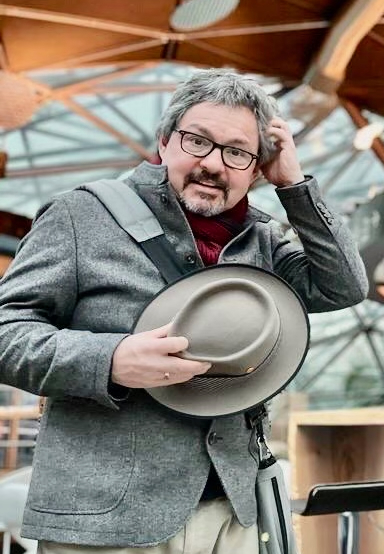
Erik Fuß ist Professor für germanistische Linguistik insb. Sprachgeschichte und historische Linguistik an der Ruhr-Universität Bochum und Herausgeber des peer-reviewed E-Journals „Evolutionary Linguistic Theory“. In seinen Forschungsinteressen verknüpft er die historische und theoretische Linguistik. Im Mittelpunkt stehen dabei Syntax und Morphologie des Deutschen und seiner Dialekte sowie Aspekte der Grammatiktheorie und theoretischen Sprachwandelforschung. Besonders interessiert er sich für Phänomene, die an der Grenze zwischen Syntax und Morphologie angesiedelt sind und potentiell Aufschluss darüber geben können, auf welche Weise diese beiden zentralen Module der Grammatik miteinander interagieren (u.a. Kongruenzphänomene, Pronominalsyntax und -morphologie (d- vs. w-Pronomen, starke vs. schwache Pronomen, Pro-drop), Zusammensetzung von Flexionsparadigmen (insbes. Synkretismen) und ihr Einfluss auf syntaktische Eigenschaften (Wortstellung, Argumentrealisierung und -kodierung, Dissimilationsprozesse/morphosyntaktische Haplologie).
Einladendes Projekt A01: Kreativität in (morpho)syntaktischer Variation: die Rolle von analogischen Prozessen.