An international research team from Bielefeld University and the Leibniz-Forschungsinstitut für Molekulare Pharmakologie (FMP) has uncovered a previously unknown regulatory mechanism in human cells. For the first time, they demonstrate how a key molecular switch regulates the cell’s “recycling centers.” The findings, published in the prestigious journal Nature Communications, provide important insights into the understanding of cancer and neurodegenerative diseases.
Key facts at a glance:
• Researchers from Bielefeld University and the Leibniz-Forschungsinstitut für Molekulare Pharmakologie (FMP) in Berlin have identified TBC1D9B as the long‑sought “off switch” for the key lysosomal regulator ARL8B.
• Without this regulator, the cell’s metabolic control centers lose balance and fail to respond properly to nutrient deprivation.
• The findings open new perspectives for therapies targeting Alzheimer’s, Parkinson’s disease, or cancer.
Lysosomes are the control centers for the metabolism of cells and tissues, including the brain. They break down defective proteins and other macromolecules into their basic building blocks. At the same time, they determine whether a cell grows or switches into an energy-saving mode. In doing so, they play a key role in health and disease.
© Klaudia Kosieradzka, FMP, Berlin
A research team led by Prof. Dr. Markus Damme of Bielefeld University and Prof. Volker Haucke, Director of the Leibniz-Forschungsinstitut für Molekulare Pharmakologie (FMP), has now jointly elucidated a key mechanism underlying this regulation. “For the first time, we’re showing which protein turns off the central transport switch ARL8B,” says biochemist Markus Damme, who was recently appointed to Bielefeld University from Kiel. “This gives us a better understanding of how cells spatially organize their recycling centers—or, more specifically, their sustainability centers—and adapt them to nutrient deprivation,” adds Prof. Volker Haucke, who is the co-last author of the study alongside Markus Damme.
At the heart of this work, which was carried out through close collaboration between the teams led by Prof. Volker Haucke in Berlin and Prof. Markus Damme in Bielefeld, as well as researchers at Christian-Albrechts-Universität Kiel (CAU), is the protein ARL8B. It acts like a motor starter: when active, lysosomes travel along a cellular rail network—known as microtubules—to the cell periphery. There, they promote growth processes. Until now, however, it was unclear how this switch is turned off again.
A newly discovered counterpart
The Bielefeld researchers identified the protein TBC1D9B as the crucial “off switch.” TBC1D9B binds to the lysosomal membrane protein TMEM55B and specifically inactivates ARL8B. Experts refer to this as a GAP function (GTPase‑activating protein), a mechanism that returns molecular switches to their inactive state.
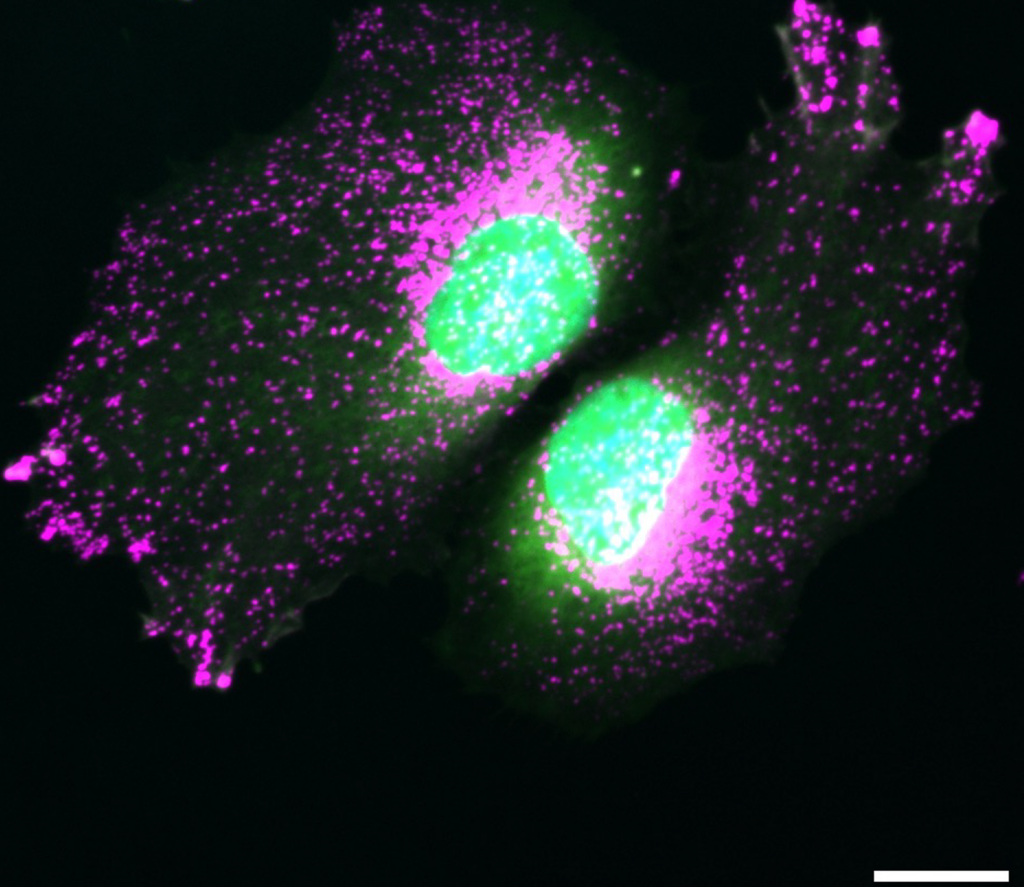
“When TBC1D9B or its partner TMEM55B is missing, lysosomes lose their organized positioning. They spread uncontrollably throughout the cell,” explains doctoral researcher Valentin Duhay from CAU Kiel, co-first author of the study. This becomes particularly dramatic under nutrient deprivation: “Normally, lysosomes then move toward the center of the cell and boost the degradation process—the so-called autophagy, a kind of cellular self-cleaning. Without the newly discovered regulator, this adaptation does not work,” adds FMP researcher and co-first author Dr. Miaomiao Tian.

© Bielefeld University
Relevance for medicine and society
The study combines state‑of‑the‑art proteomics, genome editing, and high‑resolution microscopy. It demonstrates in unprecedented detail that not only the presence but also the precise positioning of lysosomes determines their function.
Lysosomal dysfunction plays a key role in Alzheimer’s disease, Parkinson’s disease, inherited metabolic storage disorders, and cancer. When lysosomes are impaired in their regulatory and recycling functions, harmful protein deposits accumulate, for example in the brain, or tumor cells exploit these systems for their own growth.
Statement by Professor Damme and Professor Haucke
“Our findings provide the missing piece of the puzzle regarding the regulation of ARL8B. This discovery opens up new avenues for specifically influencing pathological processes such as tumor growth,” said Professor Dr. Markus Damme on the subject. Prof. Volker Haucke adds: “By specifically intervening in the signaling processes at the lysosome, we could, for example, make nerve cells more resilient and thus prevent or delay dementia, or activate immune cells—which are also dependent on ARL8—to combat viruses or bacteria more effectively.”
Original publication

Valentin Duhay, Miaomiao Tian, Klaudia Kosieradzka, Michael Ebner, Wen‑Ting Lo, Michael Krauss, Henner‑Linus Sprengel, Matthias Voss, Mara Riechmann, Jeffrey N. Savas, Michael Schwake, Volker Haucke and Markus Damme: Control of lysosome function by the GTPase‑activating protein TBC1D9B and its binding partner TMEM55B. Nature Communications. DOI: https://doi.org/10.1038/s41467-026-70345-y. Published on 14.03.2026.