The divide runs along hard numbers—how much someone earns; where they live; or what access they have to education, healthcare, or political participation—and these are all measurable. These objective differences shape the everyday lives of millions of people in Germany, and they are often the starting point for social tensions. The Focus Area CoIn aims to get to the bottom of how these interrelate.
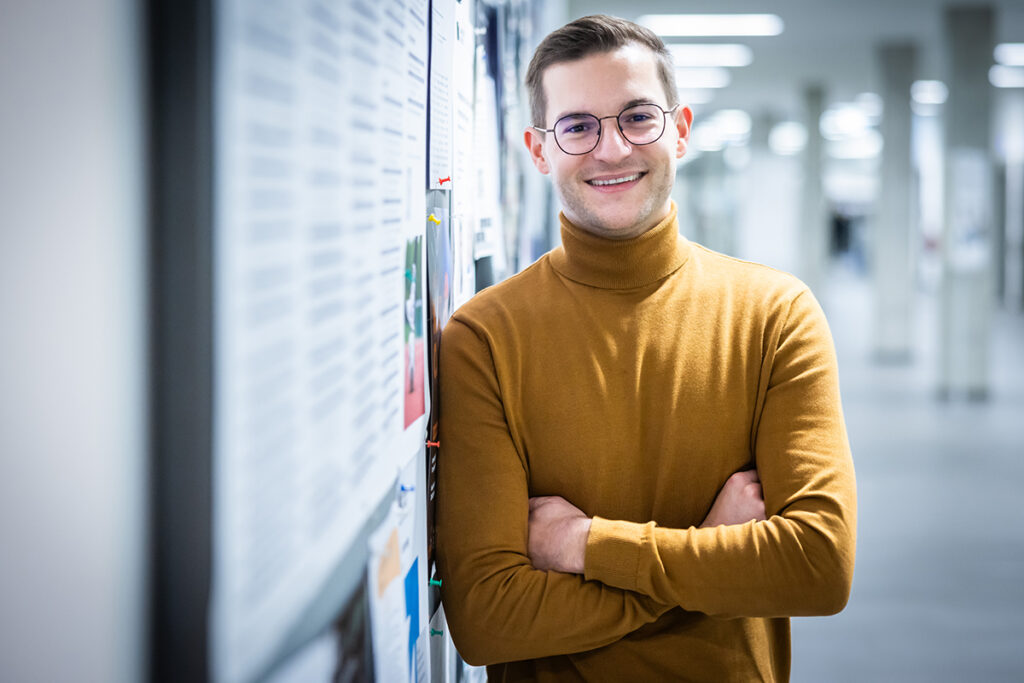
‘We are seeing an increasing number of conflicts that can be traced back directly or indirectly to issues of social inequalities,’ says Professor Simon Kühne, sociologist at Bielefeld University. He is the coordinator and co-spokesperson for the Focus Area. ‘These conflicts concern resources such as money, influence, or access to opportunities—that is, precisely those areas in which inequalities are found.’
Research is focusing on the interplay between inequality and social conflict: empirically, interdisciplinarily, and with relevance to current social trends. ‘We still see gaps in research here. We need to understand this interplay better,’ he says.
© Sarah Jonek
Getting to the root of conflicts
There are more than 30 researchers from six disciplines participating in CoIn: sociology, psychology, health sciences, history, economics, and data science. The topics they are investigating include inequalities in access to healthcare, different family models, regional living conditions, and political polarization. The researchers are looking not only at causes but also at dynamics: what interactions exist? What conflicts arise from inequalities? And how do conflicts reinforce existing differences?
One aspect that runs through all of this is technological change. ‘Digital technologies and AI are often seen as neutral entities that benefit everyone,’ says Simon Kühne. ‘But in reality, new inequalities are emerging in terms of access and usage behaviour.’ Who benefits from generative AI? Who is left behind? ‘Some groups will profit from this and advance their careers, whereas others will lose out when their jobs are eliminated by change.’
The research in this Focus Area is empirical in nature. ‘We work with classic social science methods, but also with new digital data sources and data science approaches.’ These include social media data, comments on online platforms, and image analyses from Instagram—each combined with quantitative or qualitative methods.
OEP RegioHub: regional living environments in the focus of research

The CoIn research is supported with long-term data from the SOEP RegioHub, the Leibniz ScienceCampus Bielefeld, and the German Socio-Economic Panel (SOEP) of the German Institute for Economic Research (DIW Berlin). Launched in 2020, the joint project is utilizing and extending the surveys conducted by SOEP, the largest and longest-running multidisciplinary long-term study in Germany. ‘20,000 households have been surveyed since 1984,’ says Simon Kühne.
‘We are combining these data with regional structural data on, for example, unemployment, educational infrastructure, or medical care.’ The aim is to uncover the correlations between local living conditions and political attitudes, health, or economic success. ‘Do I have a better chance of being healthy if I live in a wealthier region or city? We want to get to the root of questions like these.’
One RegioHub project is investigating the content and tone of reporting on migration in local newspapers. The aim is to identify how reporting influences political attitudes in each different region. ‘After all, media narratives can also contribute to division,’ says Kühne.
Sharing knowledge with society and politics
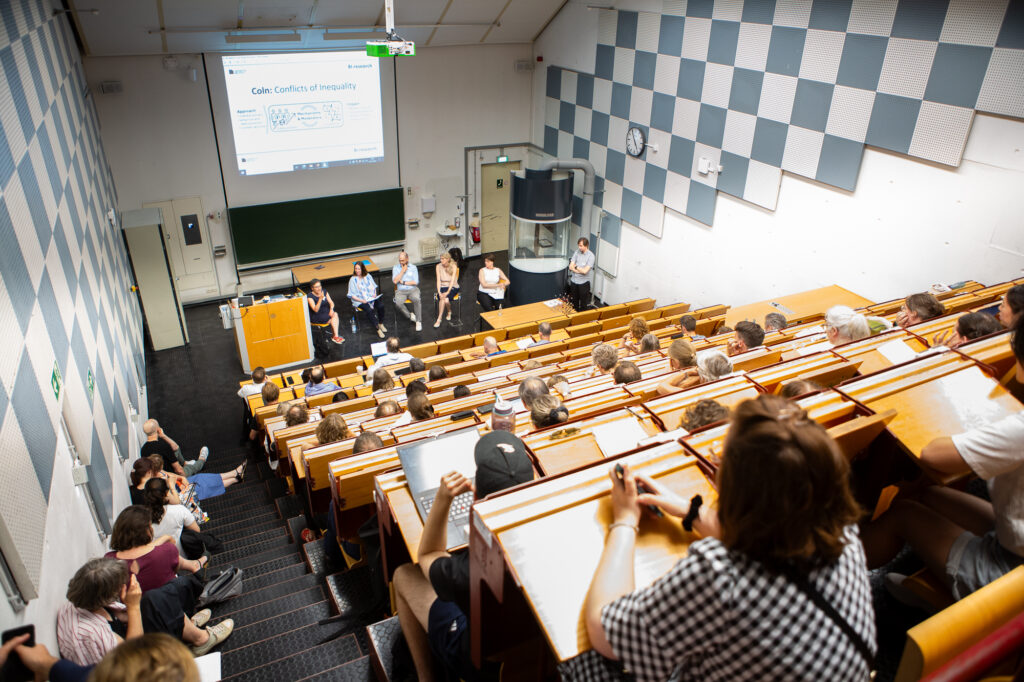
CoIn views itself not only as a research platform, but also as a place of transfer. Recommendations on how decision makers should act, meetings with citizens and politicians, and interactive tools are planned. ‘One possibility could be an “inequality conflict monitor” that would compare topics discussed in different regions over a certain period of time,’ says Kühne.
To this end, CoIn is working closely with ‘ConflictA’ (the Konfliktakademie) at Bielefeld University’s Institute for Interdisciplinary Research on Conflict and Violence, which is funded by the Federal Ministry of Research, Technology and Space. Since 2023, ConflictA has been developing innovative formats for science communication such as dialogue events, workshops, or digital formats. ‘We at CoIn benefit from this experience.’
© Stefan Sättele
Students and doctoral candidates are actively involved in CoIn. Starting in the winter semester of 2025/26, study courses have been expanded to include thematically relevant seminars and lectures. Postdoctoral researchers will also have the opportunity to develop their own projects and advance their academic careers. ‘It is important to us to give postdocs the chance to make a name for themselves in their field, communicate their research, and take active advantage of our network.’
Simon Kühne himself is looking forward to starting the actual research work after the long planning phase. ‘And that in new constellations,’ he says. ‘Interdisciplinary exchange offers great potential—also for looking at social challenges from new perspectives.’
The Focus Area CoIn
Focus Area:
Conflicts of Inequality (CoIn)
Spokespersons:
Professor Dr Simon Kühne, Professor Dr Tobias Hecker, Professor Dr Anna Oksuzyan
Coordination:
Professor Dr Simon Kühne
Faculties:
Sociology, Psychology and Sports Science, Business Administration and Economics, Public Health, History and Philosophy and Theology
Institutions:
Institute for Interdisciplinary Research on Conflict and Violence (IKG), Center for Uncertainty Studies (CeUS)
Website: https://www.uni-bielefeld.de/forschung/profil/fokusbereiche/coin/
Background: Focus areas are interdisciplinary research networks at the university. Each of the 13 focus areas builds on successful research approaches and externally reviewed research projects – a strong foundation for scientific excellence.