Can artificial intelligence work side by side with doctors to help them make better diagnoses? A research team at Bielefeld University is dedicated to answering this question. They are working on an interactive AI system that accompanies doctors as they make a medical diagnosis by reviewing and evaluating assumptions in dialog with them.
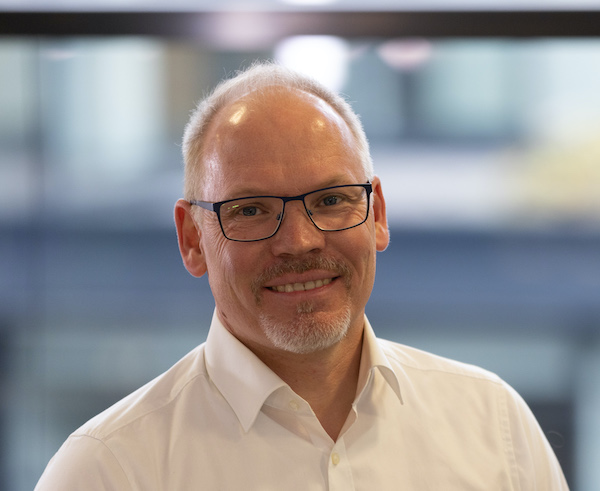
Artificial intelligence (AI) is becoming increasingly important in medicine: intelligent systems can sort through large volumes of data in seconds flat, analyze X-ray or MRI images, identify abnormal findings, and even make diagnoses. But how does AI arrive at its conclusions? This is where project C05 at the “Constructing Explainability” TRR 318 at Bielefeld University and Paderborn University comes in. As Professor Dr.-Ing. Stefan Kopp explains, the challenge here is not only about providing “diagnostic support, but also reasoning support.” The goal is not for the AI to provide ready-made medical recommendations per se, but rather to assist medical professionals in their decision-making process by asking questions and discussing hypotheses. “Kind of like a lane-departure assistance system in driving, this AI too would ensure that the doctor does not overlook anything important during the diagnostic process and would provide guidance on what else might need to be considered,” says Stefan Kopp, who is working on this basic research together with Professor Dr. Philipp Cimiano and two doctoral researchers. At the heart of this system is the ASCODI system, a prototype developed and refined by computer scientists and cognitive scientists to enable humans and machines to work together as a team and arrive at a good diagnosis—step by step. “And this means not only being as accurate as possible, but also understandable and justifiable,” says Kopp.
© Bielefeld University
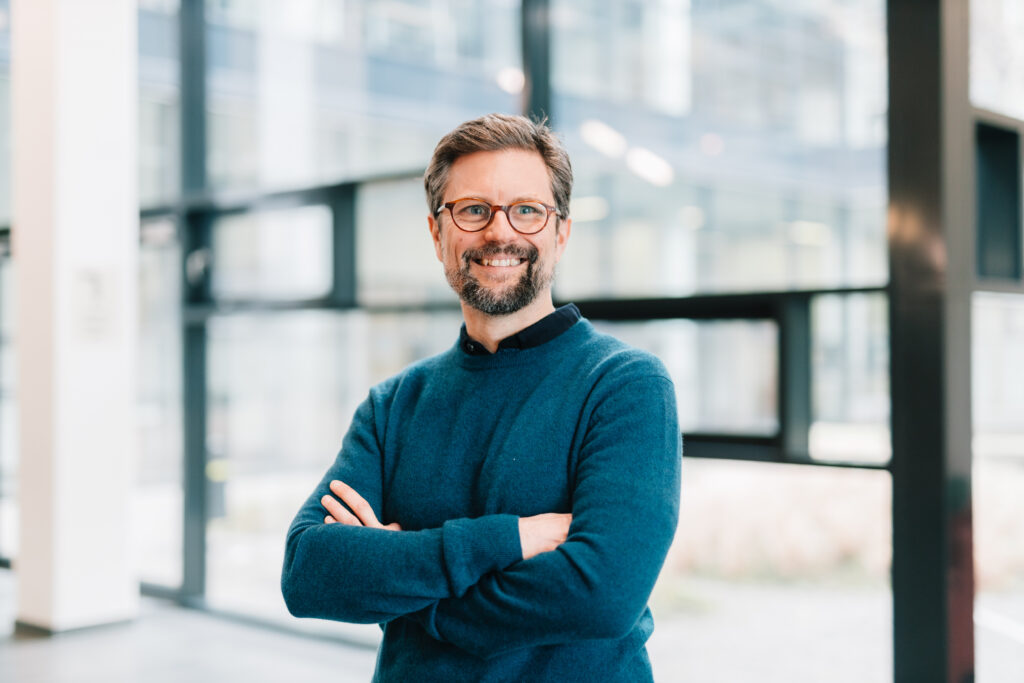
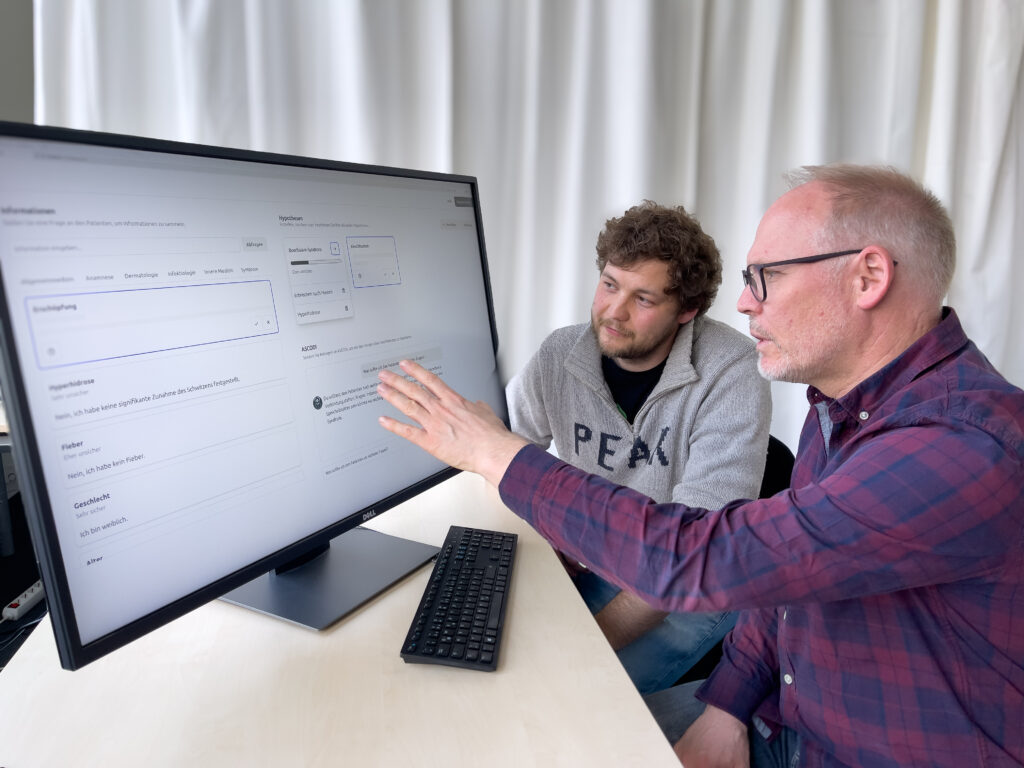
To show how this works, doctoral student Dominik Battefeld turns on his screen and slips into the role of a doctor using the ‘assistive co-constructive differential diagnosis system,’ or ASCODI for short. He clicks on the button ‘Start Diagnosis’ and is presented with a simulated patient: female, 32 years old, presenting with a severe cough. Dominik Battefeld checks additional information on the dashboard and then asks the AI: “What should I do next?” ASCODI reminds him to check for fever and vomiting and provides him with an assessment of how likely or unlikely illness X or Y is. “It’s like a virtual colleague with whom I can discuss the case,” says Battefeld. The smart assistance system provides answers, but also intervenes proactively, asking questions and setting red lines that should not be crossed where there is uncertainty or doubt. For example, the system warns that, at this point in the diagnostic process, it is not warranted to rule out the hypothesis that Dominik Battefeld is trying to delete.
© Bielefeld University/M. Adamski
Making AI Understand How Doctors Think
In order for ASCODI to be able to do all of this, the AI system was first uploaded with medical information, which was then used to train it to associate symptoms with diseases. This included a dataset with 1.3 million simulated patients. But the Bielefeld cognitive scientists are taking this a step further: their model is meant to understand how doctors think and how they make diagnoses. “This doesn’t yet exist,” emphasizes Stefan Kopp. Medical decisions are complex, and every doctor has their own strategy. The researchers distinguish between two broad types of diagnostic approaches: those who develop hypotheses quickly and intuitively based on knowledge and experience, and the more analytical types, who gather a great deal of information and work more slowly. ASCODI should recognize the doctor’s process—and help counteract cognitive biases. Maybe the doctor has a lot of expertise in one area, which could run the risk of overlooking other possibilities. Doctors might commit to a diagnosis too early, only paying attention to what supports their assumptions. In practice, such misjudgments occur again and again, especially when working under time pressure, as Kopp explains. “The error rate in diagnoses is estimated to be up to ten percent.”
© Andreas Zobe
Can ASCODI Reduce the Error Rate in Diagnostics?
The researchers regularly discuss their findings with medical professionals from clinics throughout Germany. Philipp Cimiano, for instance, conducted a study to investigate how doctors respond to AI recommendations and how they rate these suggestions in their professional opinion. “We are developing approaches that allow the diagnoses suggested by AI to be explained and justified to the treating physicians,” Cimiano says. Previous findings have shown that conventional approaches to explainable AI often fall short. “Doctors need well-reasoned justifications that present the facts and draw statistical conclusions from them. However, the rationales should not be too complex, as doctors have limited time to consider explanations from AI systems.” Cooperation partners on this project include the Epilepsy Center in Bochum and the University Clinic for Epileptology at the Mara Hospital in Bielefeld-Bethel. Epileptology is well suited to this research because the investigation of epileptic seizures is highly complex. Dr. med. Christian Brandt, who heads the Bethel Epilepsy Center and is a professor of Epileptology at the University Hospital, sees promising opportunities for this technology to help make diagnostics faster and more precise: “However, the risk is that the AI becomes an opaque black box.” This is exactly what ASCODI is designed to prevent.

© Bielefeld University/Sarah Jonek
Further studies are needed to demonstrate whether the prototype meets these expectations. How does working with an AI affect doctors’ behavior? Does this collaboration actually work in practice? What are the limits of this? Does the technology maybe even lead users to rely on it excessively—handing over too much responsibility to the machine? More testing will be carried out in the coming year. Another idea is that the system could be used in medical school or as a training tool. In any case, for the researchers it is a scientifically exciting project with social relevance. “Having a mathematical model of how and why doctors arrive at different diagnoses is a scientific challenge and it has added value if it works,” says Dominik Battefeld. Stefan Kopp also sees great potential in this basic research: “Using technology to support doctors who are under a lot of pressure and help reduce misdiagnoses is an exciting perspective for this promising application.”
Collaborative Research Center 318 “Constructing Explainability”
In the Transregional Collaborative Research Center 318 “Constructing Explainability”, researchers from Bielefeld University and Paderborn University are developing ways to involve users in the explanation process and thus create co-constructed explanations. The lack of transparency behind algorithms can make it difficult to understand and accept the suggestions proposed by AI. How does AI arrive at its conclusions? On what basis are decisions made? Under the banner of “Constructing Explainability”, such questions are being investigated in 20 interdisciplinary projects. Project C05, “Creating Explanations in Collaborative Human-Machine Knowledge Exploration,” is one of these projects.