Pure water only freezes at around minus 38 degrees Celsius. Tiny mineral dust particles act as so‑called ice nucleators—crystallization seeds on which ice crystals form. A research team at Bielefeld University and the University of Vienna in cooperation with researchers from Helsinki University has now demonstrated for the first time, at the molecular scale, why the mineral microcline is particularly effective at forming ice in clouds. Published in a renowned scientific journal, the study provides a new explanation for processes that influence climate and precipitation worldwide.
Key facts at a glance:
- The mineral microcline forms ice already on its most common, most stable surface.
- Spatially ordered aluminol groups on the surface bind water particularly well.
- The researchers directly visualized ice clusters at the nanometer scale.
The process under investigation helps determining when water in clouds freeze, how much precipitation falls, and how strongly clouds reflect sunlight. All of these factors play a crucial role in the climate.
‘We wanted to understand why microcline is so exceptionally good at forming ice, even though it differs only slightly in chemical composition from other feldspars, a group of common rock-forming minerals,’ says Dr. Florian Schneider from Bielefeld University, first author of the study. ‘Our results reveal for the first time at the molecular level what makes this mineral so special.’
In this project, we are investigating ice formation on surfaces. And in our case, it is specifically about ice formation in clouds. To understand that, you need to know that pure liquid water only freezes at minus 38 degrees Celsius. But if another substance is present, for example Sahara dust, then ice can freeze on such a surface at much higher temperatures.
So we study ice Formation on surfaces and ask: Why are some minerals known to form ice very well, while others, which are chemically very similar, are not? What is special here is that we looked at it on the nanoscale. Before that, there had already been measurements with an electron microscope, which could show on the micrometre scale where on such a microcline crystal the ice crystals grow. And those measurements always showed that they grow out of cracks.
We looked at two different feldspars, which are minerals that occur in nature, and we wanted to understand why microcline, which is chemically identical to sanidine, is so much better at triggering ice nucleation in clouds. In other words, we looked at it very specifically. What actually distinguishes these two minerals?
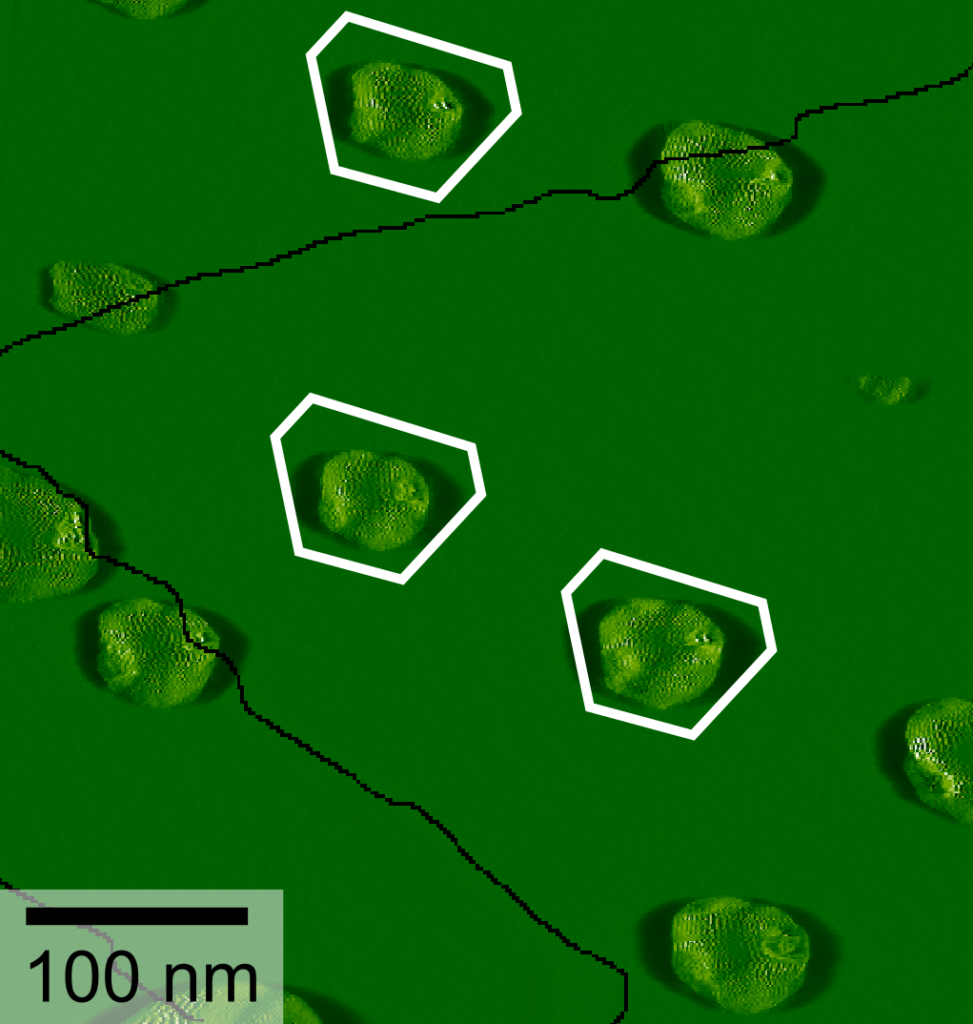
To examine this, we used single crystals of the minerals, which we then introduced into our ultra-high-vacuum chamber. This is important so that we have minerals with a mineral surface that is perfectly clean and has therefore not come into contact with oxygen or other gases in the air. We heat the crystals in the chamber to remove further impurities. We then examine the surface using so-called atomic force microscopy. This allows us to capture images of the surface on the nanoscale, and then to see when ice crystals grow, at what pressure, and, above all, where.
As soon as the water vapour pressure is high enough for ice crystals to nucleate, I can see ice crystals growing on the surface, and not just at step edges, but also on the perfectly flat terraces. Our research now strongly suggests that even this very stable surface, which we believe is much more exposed than others, can already nucleate ice.
For climate research, this is relevant, because accurate climate modelling requires knowing: How much sunlight is reflected, and how much is absorbed? In other words, we are doing basic research into why some minerals are particularly good, and later, in climate models, you can look at: How much of these minerals do we have in the clouds? And how does the climate develop as a result?
What’s particularly interesting is that, despite all the research we do, we still cannot really predict which materials are truly good ice-formers and which are not. What we would like to achieve is the ability to predict that if a material has the following properties, then it is good for ice nucleation, or vice versa. You always want surfaces that prevent ice formation. And that is the major goal we would like to achieve.
Ice grows in an ordered way on a stable surface
Feldspars are among the most abundant minerals in atmospheric dust. Microcline—chemically potassium aluminum silicate—is considered an extremely effective ice nucleator. Until now, researchers assumed that ice forms mainly at rare surface features such as step edges or cracks, so‑called active sites.
© Bielefeld University

© Magnus Krenz
The research team has now shown that, in the case of microcline, its most common and thermodynamically stable surface—the so‑called (001) cleavage plane—is sufficient. Ice grows there in an ordered manner, a process known as epitaxial growth. This means that the crystal lattice of ice aligns at a fixed angle with the crystal lattice of the mineral.
‘Interestingly, the (001) surface of microcline does not match with the common surfaces of hexagonal ice. Instead, the ice crystals grow with a less common surface, a so-called higher index plane, aligned to the microcline structure,’ says Dr. Tobias Dickbreder from the University of Vienna, last author of the study. ‘This finding provides a new perspective on the importance of uncommon ice faces for understanding ice nucleation.’

© Magnus Krenz
Nanometer-scale images provide crucial evidence
The discovery was made possible by high‑resolution atomic force microscopy under ultra‑high vacuum conditions. The researchers cooled the samples and directly observed where tiny ice clusters formed. Complementary computer simulations confirmed the experimental findings.
For comparison, the team also studied the closely related mineral sanidine. Although it has the same chemical composition as microcline, ice forms on sanidine mainly at step edges, as classical theory predicts. The difference appears to lie in the surface structure: the most stable surface of microcline carries roughly twice as many so‑called aluminol groups. These chemical groups can form strong hydrogen bonds with water molecules and stabilize the first ice clusters.
The study thus provides a long‑sought nanoscale explanation for microcline’s exceptional ice‑nucleating ability. The results show that rare surface features are not necessarily required; widespread, stable surfaces can also play a decisive role.
This is particularly relevant for climate research: even small differences in ice formation can alter cloud properties, precipitation patterns, and the reflection of sunlight. A better understanding of mineral surfaces in the atmosphere will help make climate models more accurate.
At Bielefeld University, research into ice formation on mineral surfaces falls within the strategic Focus Area ‘Architecture of Nature: Elementary Building Blocks and the Formation of New Structures’ (ANBauEn).
Original publication

Florian Schneider, Rasmus Väinö Erik Nilsson, Ralf Bechstein, Hans-Georg Stammler, Bernhard Reischl, Thomas Koop, Angelika Kühnle, Tobias Dickbreder: Ice nucleation on microcline (001) in the absence of active sites. Nature Communications, https://www.nature.com/articles/s41467-026-76548-7, published on 25 August 2026.