How can we make sound decisions in an unpredictable world? The research training group Coping with Uncertainty in Dynamic Economies (CUDE) funded by the German Research Foundation (DFG) at the Center for Mathematical Economics investigates economic uncertainty—from labor markets to climate risks. The professors Herbert Dawid and Anna Zaharieva, along with doctoral researchers Asimamaw Belete and Luoyuan Gan, share their approaches and insights.
What is CUDE’s research focus?
Herbert Dawid: Our research focuses on how individuals, companies, and governments make decisions in an uncertain world. Uncertainty arises everywhere—in financial markets, technological change, and day-to-day business operations. We use mathematical models and simulations to understand how economic agents react to unpredictable changes and how this influences the broader economy. This is crucial because uncertainty can lead to inefficient decisions, financial instability, and slow economic growth.
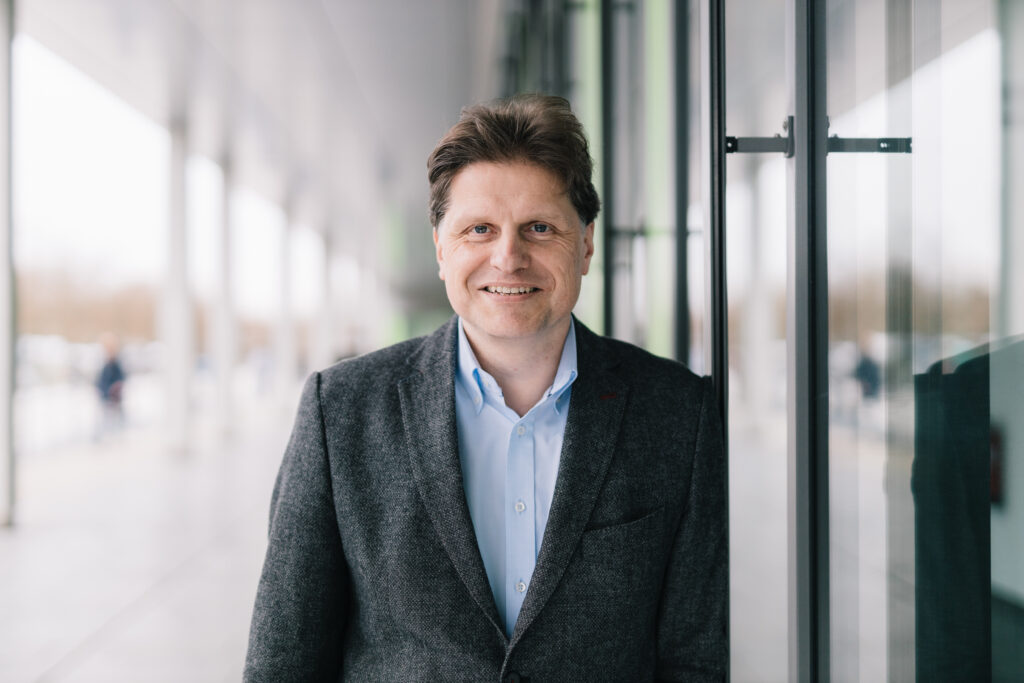
© Michael Adamski
Can you explain the different types of uncertainty your research addresses?
Anna Zaharieva: We differentiate between classical uncertainty, where the decision-maker knows the exact probabilities of outcomes—say, a 70 percent chance of an event—and Knightian uncertainty, where those probabilities cannot be reliably estimated. This deeper form, often called ambiguity, is common in real-world scenarios. At CUDE, we develop models that go beyond classical assumptions and account for this ambiguity.
Can you give other examples of this uncertainty in action?
Anna Zaharieva: During the COVID-19 pandemic businesses and workers had to quickly adjust to lockdowns, changing demand, and supply chain disruptions. Some companies thrived, while others struggled. We study these types of scenarios to understand what factors help economies recover and which policies can improve resilience. Another example is climate change. As weather patterns become more unpredictable, businesses and policymakers need to anticipate risks and adapt their strategies accordingly. These are new sources of uncertainty. And we aim to provide policymakers and decision-makers in firms with guidance and tools to navigate uncertainty in a more scientifically grounded and rational way.

© Bielefeld University/ Mike-Dennis Müller
What specific topics are you working on?
Asimamaw Belete: My project examines how job seekers navigate navigate uncertainty in the labor market. We study how people search for jobs—especially the role of social networks, mobility, and different search channels—and how this influences the effectiveness of matching job seekers with vacancies. We focus on three types of uncertainty: when a job offer will come, where it will come from, and what kind of job it will be. Using real-world data and theoretical modeling, we explore how these uncertainties shape job search behavior and what this means for improving labor market outcomes.
Luoyuan Gan: I am focusing rather on the market side. I appl real options theory to explore how firms make investment decisions under market uncertainty. We focus on how companies respond to not being able to fully predict changes in market demand, such as whether it will grow, decline, or fluctuate in the future. Specifically, we examine how firms decide whether and when to expand capacity—especially when launching new products—while facing uncertainty about demand, innovation, and policy (like taxes or subsidies). We also consider financing constraints, which are particularly relevant for young firms that lack liquidity or collateral to support their investments.
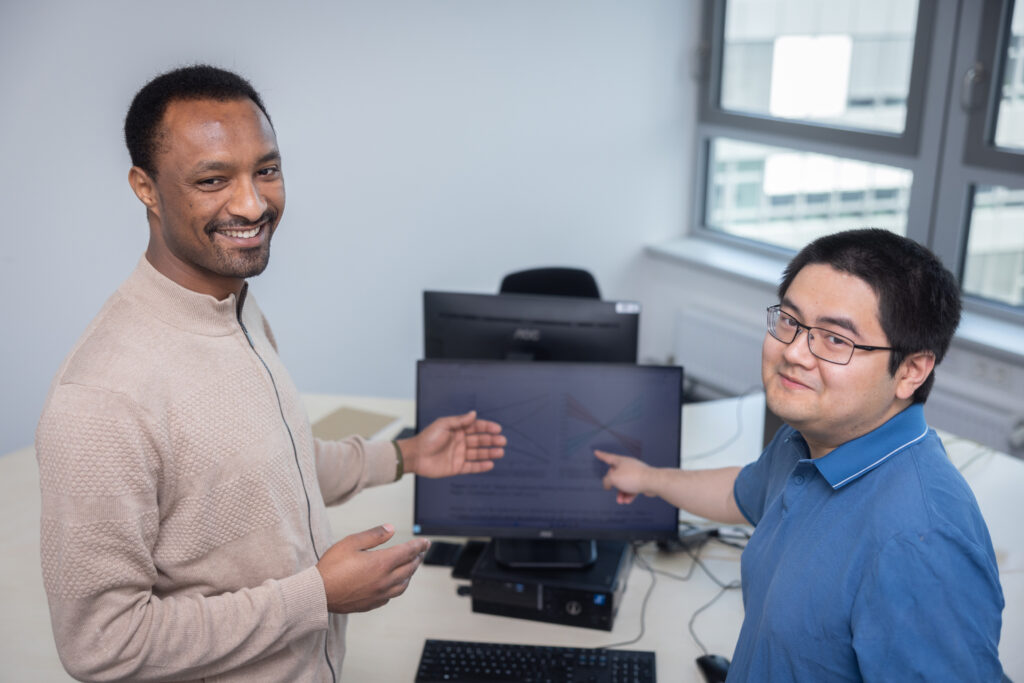
© Bielefeld University/Mike-Dennis Müller
And how do you conduct your research?
Herbert Dawid: We use mathematical and computational economic models. We formulate and analyze problems of a single decision maker, such as a firm, faces, but sometimes we also create simulations resembling entire real-world economies on a computer. These models allow us to test different scenarios—for example, what happens if governments introduce new regulations to stabilize markets or if workers switch jobs due to automation. By running these simulations, we can see the possible outcomes and suggest better policies. Our approach combines data analysis, economic theory, and computational techniques to provide a deeper understanding of uncertainty in economic systems.
What are some of the key findings from your research so far?
Anna Zaharieva: A surprising result in our project concerning labor was the relationship between job search methods and moving distance. We initially expected that relying on social networks, like professional contacts, would lead to long-distance moves. However, the data showed the opposite: people who used social networks for job search tended to move shorter distances. The primary support came from close friends and family, who are typically local, rather than from distant professional contacts, which reinforced staying close to home.
What opportunities does the program offer to PhD students?
Luoyuan Gan: The program offers strong support and many valuable opportunities for developing a research career. We have weekly seminars, a doctoral workshop with international students, and a colloquium where we can present our own work. We also have regular field-specific meetings—our so-called ‘CUDE Reading Groups’—where we discuss new findings. All these activities make the research environment dynamic, collaborative, and very helpful for our future careers.
Asimamaw Belete: I’m happy to be part of the CUDE program. As a PhD student, it’s a great learning environment where you work with people from diverse fields like data science, industrial organization, and labor economics. We have regular meetings to discuss research on uncertainty, along with training from guest professors—like those from Glasgow and the Paris School of Economics. The program also supports research stays abroad and participation in international conferences and workshops, which helps us grow our networks and gain broader academic experience. It’s a great platform for developing both research skills and career opportunities.
Partners of CUDE

CUDE research focuses on the three areas decision-making under uncertainty, strategic interactions in markets, and policy challenges such as climate change and regulation. It is an interdisciplinary endeavor and supported by the Institute for Mathematical Economic Research (IMW), the Bielefeld Graduate School of Economics and Management (BiGSEM), the Bielefeld Graduate School in Theoretical Sciences (BGTS), and the Center for Uncertainty Studies (CeUS).