Climate change, social conflicts, demographic change: societies today are heavily reliant on science to tackle major problems. What can science achieve, where are the limits of its responsibility – and how can researchers critically evaluate their methods and their scope? The Institute for Studies of Science (ISoS) addresses these questions and supports researchers in critical self-reflection. Bielefeld University has now made the institute a central academic institute. The founding directors of ISoS are Professors Dr Carsten Reinhardt, Dr Marie I. Kaiser and Dr Holger Straßheim. They explain why the university needs a centre for reflection on science.
Why does the university need another central academic institute (ZWE)?
Carsten Reinhardt: Our university conducts science in many different disciplines and every university should know what it is doing – that is what we are here for. We are the ones who reflect on science. We observe, interpret, analyse and come to conclusions about how science works. We deal with the sciences in their interdisciplinary interaction. This concerns the entire university, which is why this step towards the ZWE is a logical one.
The Institute for Studies of Science follows on from the I²SoS, the former Institute for Interdisciplinary Studies of Science. What are the advantages of the transformation into a university-wide institution?
Holger Straßheim: As a ZWE, the ISoS takes the role of an interface and a hub for reflection. It reflects on science and its practices within the university and acts accordingly. At the same time, it is an interface to the outside world, between science and politics, and provides expertise. A central academic institute is perceived differently in the university’s profiling process and can support it and build bridges. We were not able to do this in the previous insular situation, when the predecessor institute was based at the Faculty of History, Philosophy and Theology and linked to the Faculty of Sociology. And by the way: how to pronounce I²SoS was not so self-explanatory. We have now taken the opportunity to drop the “squared”. What we have not dropped is interdisciplinarity. This is a central structure within the institute, our way of working and the main reason for our existence.
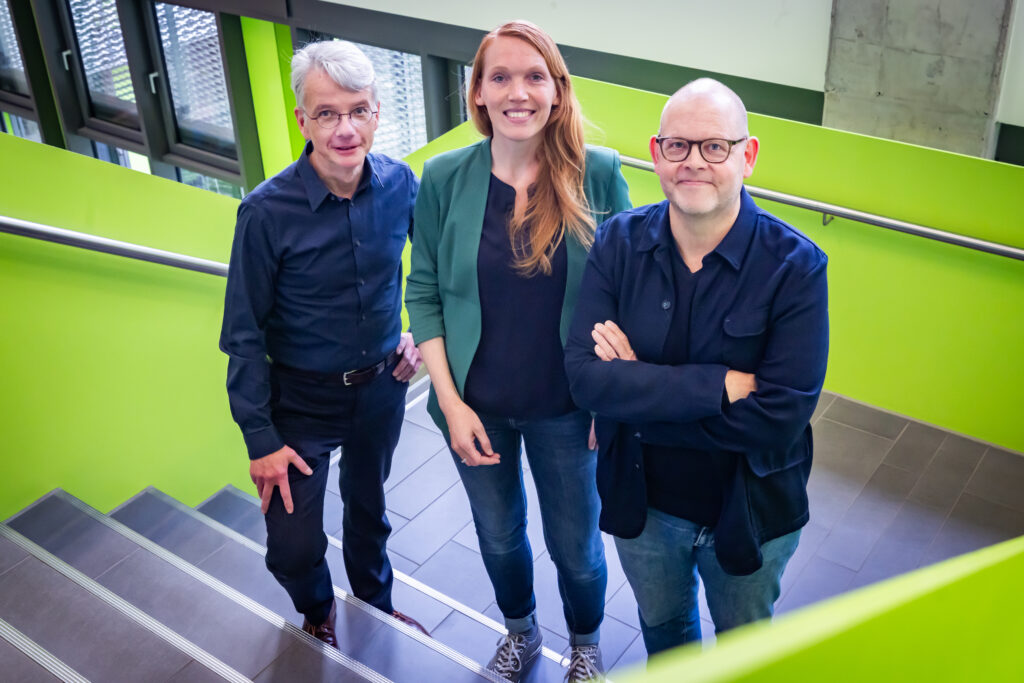
© Sarah Jonek
What was the trigger for transforming the previous institute into a central academic institute and subjecting it to repeated external evaluation?
Carsten Reinhardt: The decisive impetus came from the new medical school OWL, specifically from the Medical Humanities. This area combines medicine and the humanities in medical studies. The Ethics of Medicine working group and the History and Theory of Medicine working group were particularly involved in shaping the new ISoS. These two groups are our twin, so to speak: they do with medicine what we do with the sciences as a whole, and we thus had a critical mass of researchers. Another impetus came from Anthropocene research among historians with colleagues such as Eleonora Rohland and Franz Mauelshagen.
What is a concrete example of your work with colleagues outside of science studies?
Marie I. Kaiser: This can be explained well by the Transregio Collaborative Research Centres 212 on the individual niche. I am a philosopher and work together with biologists. While they are empirical scientists investigating how and why animals possess and develop individual characteristics, we are approaching the topic theoretically in a sub-project. We are asking what niches actually are: Spaces in the environment, quantities of causal interactions or behavioural strategies of individual animals. We clarify the meaning of terms, sharpen definitions and uncover which assumptions about the world underlie terms. This analysis and clarification of concepts is in turn taken up in the biological sub-projects, where it influences, for example, the theoretical framing of the research and the interpretation of the empirical data.
New institute conducts research across faculty boundaries

The Institute for Studies of Science (ISoS) was founded in May 2025 as a central academic institute (ZWE) of Bielefeld University. The rectorate made the decision to do so in November 2024, meaning that the university now has ten ZWE. These central institutes conduct research across faculty boundaries, combine expertise across the university and are thus able to view topics from different perspectives and explore them using multiple methods.
More than 30 scientists are currently conducting research at ISoS. ‘We are currently working on developing formats for exchange at ISoS as well as designing and planning new joint projects,’ says Dr Julie Schweer, coordinator of ISoS. Researchers at the university can be accepted as members or associated with the institute if their work fits the institute’s profile thematically – from externally funded studies to doctoral projects. Find out more about the ISoS on the institute’s website.
You mentioned that you see the institute as an interface to the outside world. What impact do you have on society?
Holger Straßheim: This is the second pillar of our ZWE – science and societal stakeholders. For example, there is a need from actors such as the European Commission to map the landscape between science, politics and social actors. How does policy advice work in different countries and in different contexts? What are the ecosystems of expertise? We can provide advice and contribute our knowledge of this landscape, trace and map interfaces and recognise the need for coordination. Of course, there are traditional institutions and advisory institutes, but there are also comparatively new platforms that are emerging. In our DFG project “The Worldviews of Ice”, for example, we are conducting an international comparative study of how Arctic policy and Arctic research interact.
You also teach your critical approach to students on the Interdisciplinary Studies of Science master’s course. What distinguishes the degree programme from similar programmes?
Marie I. Kaiser: There are two things that excite me about it. Firstly, the interdisciplinary education. We have seminars in which all three founding disciplines – i.e. philosophy, history and sociology of science – plus medicine and other object disciplines are represented. In the introductory seminar, for example, we work on how the disciplines can work together and express themselves in interdisciplinary research. The other is the dovetailing with the object disciplines – students also take seminars in natural sciences such as biology, chemistry or psychology and incorporate these insights into the reflection on science. This is quite unique.
Carsten Reinhardt: In addition, we have a very extensive research orientation even in the early phase and are highly international – more than half of our students have completed their first degree in a country other than Germany.
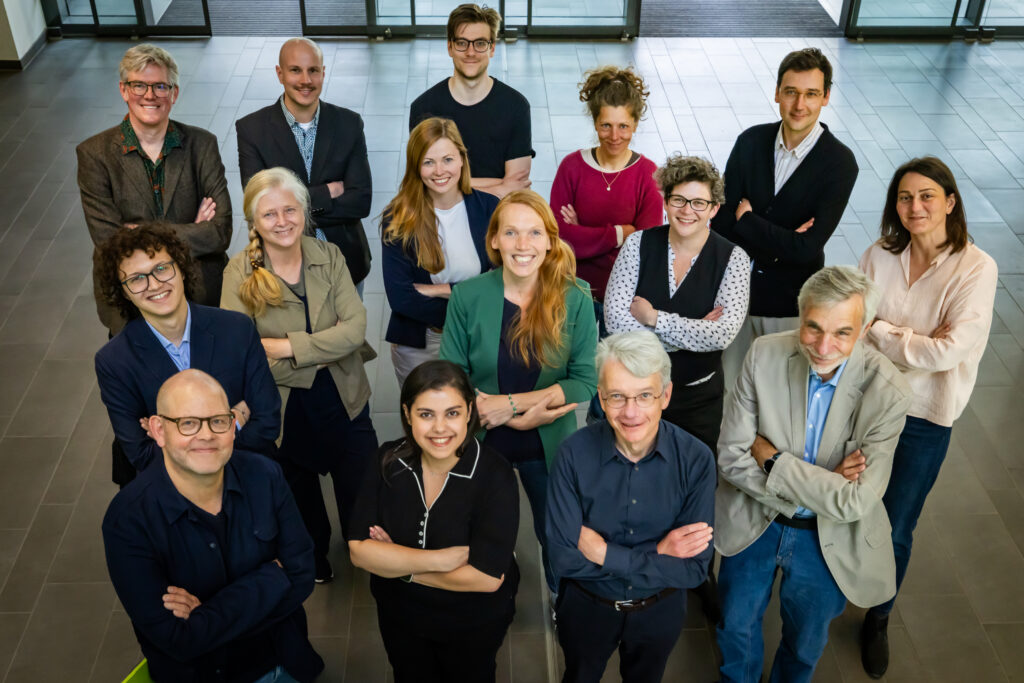
© Sarah Jonek
And how does the ISoS relate to similar organisations internationally and nationally?
Carsten Reinhardt: It’s amazing how interest in science studies has grown again over the years. This can be seen in Germany, for example, at the German Centre for Higher Education Research and Science Studies in Hanover or the Science and Technology Studies at the Technical University of Munich. Internationally, there is a centre in Paris, for example, which is currently being reorganised. Many locations have institutionalised cooperation centres. For example, there is the HPS, the Institute for the History and Philosophy of Science at the University of Cambridge, or the COI, the Centre for Organisational Innovation at Columbia University. We are in dialogue about our projects – for example, I am working on a project on environmental residues with colleagues from the universities in Princeton, Providence and Paris. What is still pending is an officially connected network of institutions like ours, both nationally and internationally. That would be the next logical step institutionally, and I definitely see opportunities there.
Bielefeld University is currently undergoing a strategic reorientation in research. Where do you see yourself in this profiling process?
Marie I. Kaiser: We are all members of the university’s focus areas, where we strengthen the reflective element of academic research. Reflection is a crucial part of the Bielefeld brand. Bielefeld University is a highly networked university where it is very easy to come together with colleagues from a wide range of disciplines. The profile development we are currently experiencing is an expression of this. We are partners in research projects on subject-specific issues and at the same time we support colleagues in sharpening their concepts and theoretically substantiating them as well as reflecting on the embedding and limits of their research. This has alienating effects and reveals the forces that drive us, for example the dynamics of external research funding, the pressure of publication cycles or the evaluation of scientists’ research performance.
Transparency notice: This translation was created with machine assistance and subsequently edited.