Ukrainian poet and scholar Dr Ostap Slyvynsky is in Bielefeld as a visiting researcher at the university. On this Thursday, 10 July at 6 p.m., he will give his public lecture ‘Ukraine 2022-2025: Why culture matters in bad times?’ at the Historical Museum. 3 questions for Ostap Slyvynsky.
Your project ‘A Ukrainian Dictionary of War’ documents war experiences. How do you connect poetic sensibility with academic methodology in this work?
From the very beginning of working on ‘Dictionary ’, I would say, there was no methodology. There was only intuition: I was witnessing something extraordinary and I could not miss a single detail, a single story. Every person, every monologue seemed extremely important to me, and I tried to remember it in order to write it down later. Of course, this was impossible. Therefore, only fragments remained in my memory, which is what makes up the book. I think this fragmentation also contributes to some literary, poetic value of ‘Dictionary’. But it was not a conscious strategy. Just as the conversations with people were not interviews. There was no plan, no preparation in this. How could you prepare for what we were experiencing in February 2022? Only later, analysing my work in February-April 2022, did I notice certain psychological, linguistic patterns. The scientist ‘turned on ’ in me. I even tried to share these observations last year during a lecture at the Pinchuk Art Center in Kyiv.
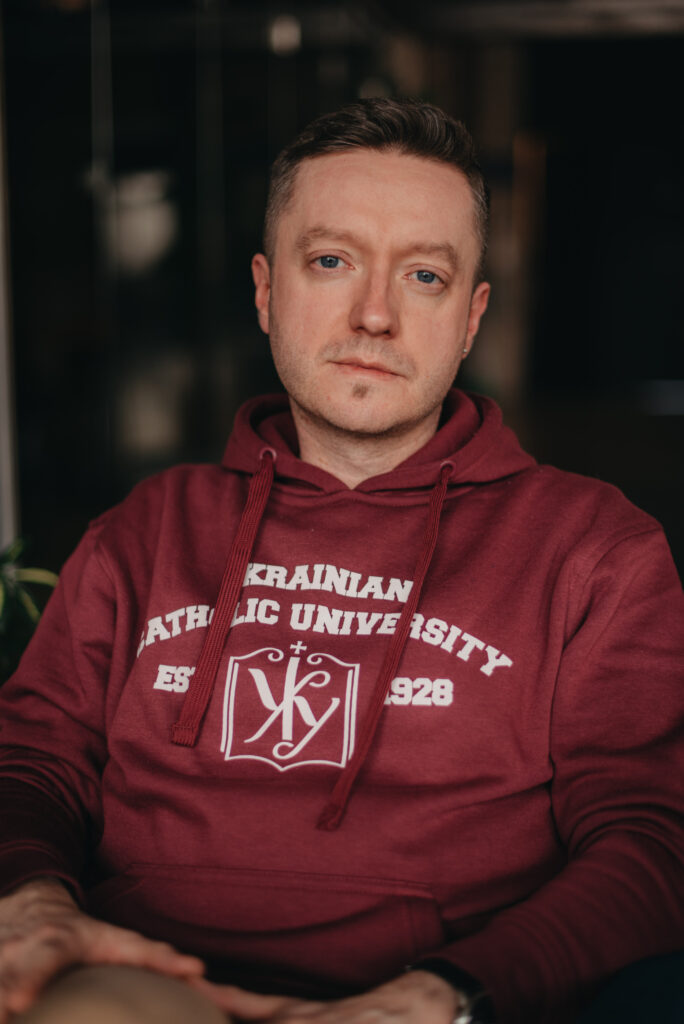
© Anton Sorochak
In your lecture on 10 July at the Historical Museum Bielefeld, you speak about important tasks of culture in difficult times – which ones, for example?
I tried to outline four most important tasks of culture in wartime, in the times of historical challenges: building and supporting the sense of community; overcoming silence; help in restoring justice; reminding of true values. This is something I have been thinking about for three years now, observing Ukrainian culture. I think that cultures of all societies that are going through historical challenges work in a more or less similar way.
You contributing to seminars at Bielefeld University on very different topics, from historical imagination to local Nazi-era history. What do you expect from this exchange with German students and colleagues?
I am really happy to work together with wonderful colleagues from the University of Bielefeld, the faculty [Faculty of History, Philosophy and Theology; editor’s note] and students, to think about these very different topics. How does our optics of the past change depending on where we are now? After all, we do not have a ‘pure’ optics, we are still inside history. You know, sometimes I feel uncomfortable thinking that future generations, who, I hope, will live in peace again, will look at us with such pity and condescension: poor things, they were so unlucky to be born in such a time… We did not choose this, but we can at least take the most benefit from it, leaving a meaningful testimony. Combining the view from Germany and Ukraine can not only be a consolation: we are not alone. It also helps to understand what our values are today, our common home – Europe.
Also poetry reading scheduled

In addition to his participation in university seminars, Slyvynsky will give a poetry reading for the reading circle of the German-Ukrainian Society Bielefeld. Born in Lviv in 1978, the author is an Associate Professor at the Ukrainian Catholic University, an award-winning translator, and has served as Vice President of PEN Ukraine since 2022.