© Tim Schubert
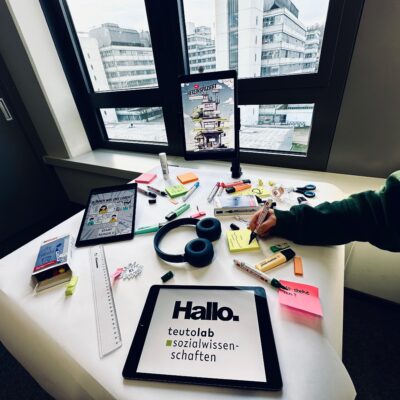
Live Ideas: New teutolab for Social Sciences launches
Bielefeld University is establishing a new extracurricular learning space with the teutolab for social sciences. Combining politics, economics and sociology, it invites young people to critically explore everyday life, social conflicts and future challenges.
Read more »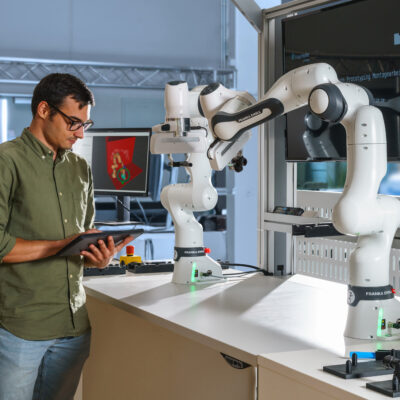
© indigo(c)2023
Humans and Machines as a Team: New “Humation” Alliance
How can humans and machines be brought together in ways that benefit both? This question drives the new competence network Humation – Human-Centred Automation, founded jointly by Bielefeld University and the Fraunhofer IOSB-INA in Lemgo.
Read more »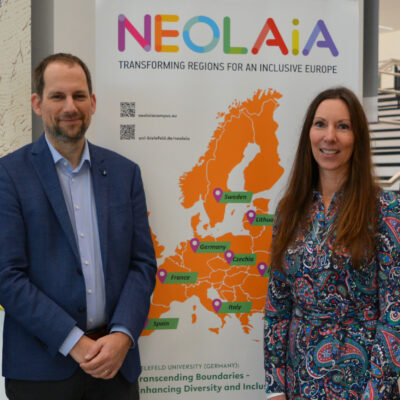
© Norma Langohr/ Bielefeld University
Europe meets in Bielefeld
The NEOLAiA Focus Academy celebrated its premiere at Bielefeld University, bringing together students from across Europe to explore digital transformation and entrepreneurship.
Read more »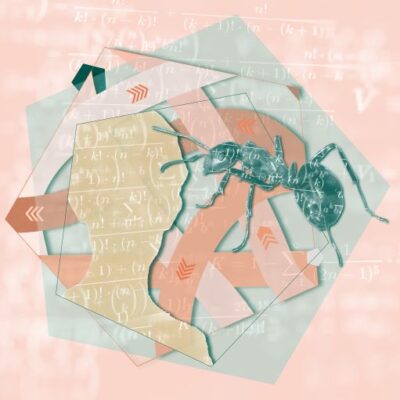
© ZiF
Robust Decisions in Natural and Artificial Intelligence
People, animals and AI make decisions every day under conditions of uncertainty. A new international research group at ZiF Bielefeld is investigating robust decision-making strategies for this purpose. For the first time in a workshop from 8 to 19 December.
Read more »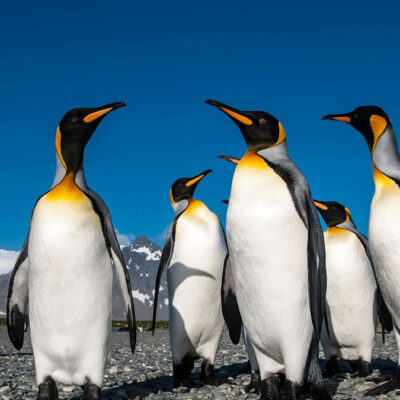
© Oliver Krüger
Focusing on the individual: how diversity advances research
What makes individuals unique—and why is that important? The new focus area InChangE delivers insights.
Read more »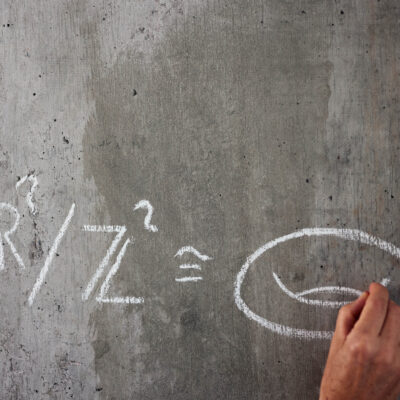
© Bielefeld University/ Patrick Pollmeier
New paths in mathematics
The ESyMath focus area aims to bring together different areas of mathematics and related sciences in order to exploit and further develop synergies.
Read more »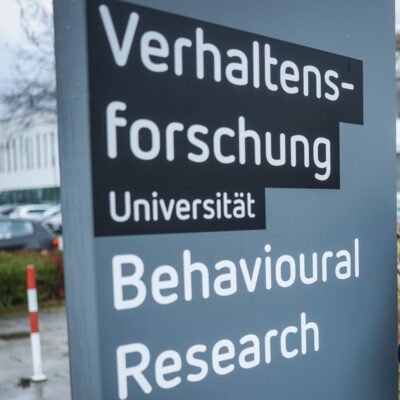
© Universität Bielefeld /Sarah Jonek
Research Team Explores Inclusion at Conferences
A research team from Bielefeld University investigates how inclusive academic conferences really are and offers concrete recommendations to promote participation and diversity.
Read more »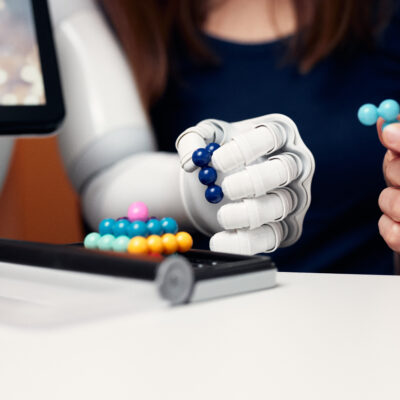
© Bielefeld Univerity
How humans and AI work as a team
How can cooperation succeed between humans and AI? The FAITH focus area at Bielefeld University is researching the hybrid teamwork of tomorrow.
Read more »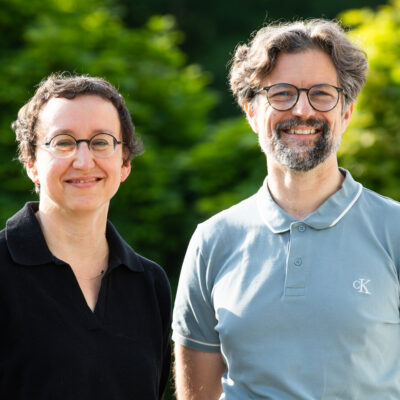
© TRR 318/ Stefan Sättele
Developing explanations together
After four years of intensive research, the Transregional Collaborative Research Centre 318 “Constructing Explainability” takes stock. In this interview, the two spokespersons share key insights.
Read more »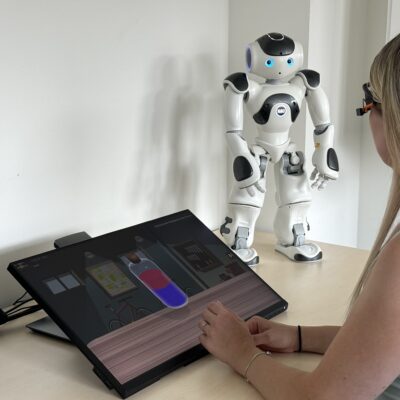
© TRR 318
Robot Nao as an Attentive Explainer
How can a robot best support us linguistically in solving tasks? Researchers from TRR 318 Constructing Explainability have investigated this question.
Read more »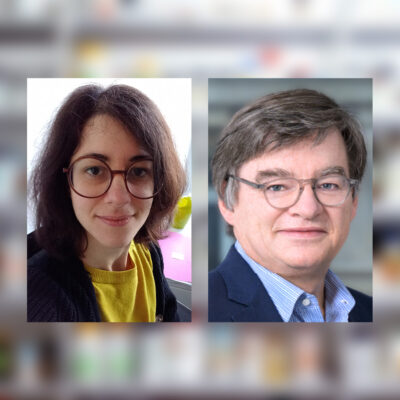
© privat
How to Understand Complex Systems
An international research group on the theory of random matrices is being launched at the ZiF in Bielefeld. It is investigating how new methods can be used to better understand complex systems ranging from ecology to AI.
Read more »
© Puay/stock.adobe.com
‘We are the ones who reflect on science’
The new Institute for Studies of Science (ISoS) helps researchers to critically scrutinise their academic work.
Read more »
© © Andreas Zobe
Making Better, More Explainable Medical Diagnoses with AI
Can artificial intelligence work side by side with doctors to help them make better diagnoses? A research team at Bielefeld University is dedicated to answering this question.
Read more »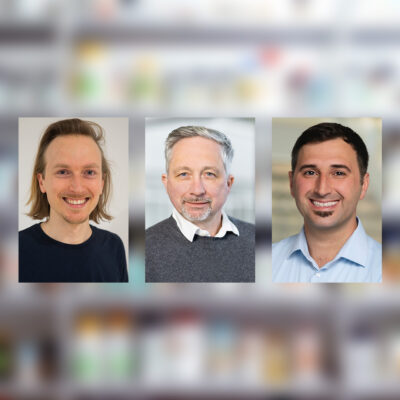
© Gent, Bielefeld and Waterloo Universities
Counting with uncertainties
The theory of imprecise probabilities is the focus of ISIPTA 2025 at the Bielefeld ZiF.
Read more »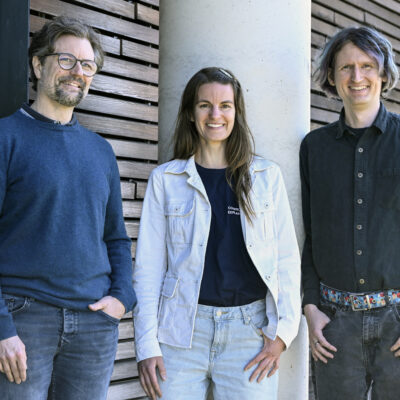
© TRR 318
Looking at Explanations of AI in Context
How can explanations of artificially intelligent systems be made comprehensible, and what role does context play in this? These questions are the focus of the 3rd TRR 318 conference ‘Contextualising Explanations’, which will take place on 17 and 18 June in Bielefeld.
Read more »
© tawatchai1990/stock.adobe.com
How the past can help understand the climate
Interview with Dr. Franz Mauelshagen about climate, society, and the new graduate school IMPRS-ModA.
Read more »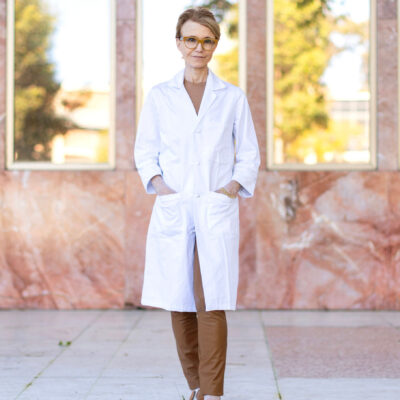
© Alisha Jucevic
Individualisation in Change
How do humans and animals navigate life transitions? The Individualisation Symposium 2025 explores biological, psychological, and social turning points – on March 25 at ZiF Bielefeld.
Read more »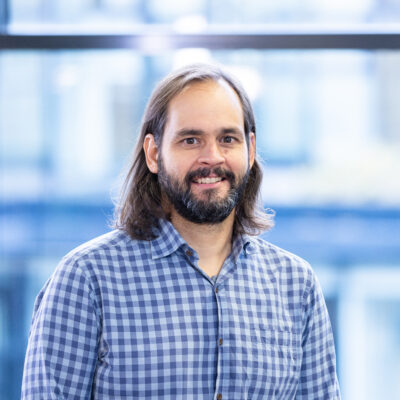
© TRR 318/ Mike-Dennis Müller
‘Development of new interactive decision-making systems’
Bielefeld University has set up an independent research group to investigate explainable artificial intelligence (XAI) and its influence on human trust in AI. In this interview, its head Dr David Johnson talks about its aims and methods.
Read more »
© Philipp Ottendörfer
‘Understanding uncertainty as a driver of innovation’
Center for Uncertainty Studies (CeUS) establishes new research approach.
Read more »
© Bielefeld University
Philosophical Engagement with Biology and Medicine
In an interview, philosopher of science Alkistis Elliott-Graves describes the special features and challenges of the ZiF workshop “Philosophical engagement on biology and medicine”.
Read more »
© Universität Bielefeld/Martin Stoffel
Return of the Elephants Seals: From a Few to Thousands
A new international study led by Bielefeld University has revealed the genetic impact of hunting on northern elephant seals.
Read more »
© Mike-Dennis Müller
50 years of Laborschule and Oberstufen-Kolleg
The experimental schools invite to an anniversary week in September. They research and develop learning structures and content together with their respective research units at the university.
Read more »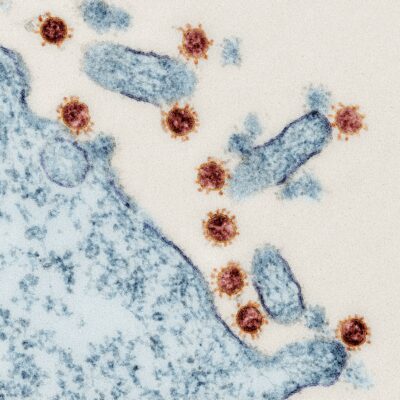
© Tobias Hoffmann, Carina Jahnke (colouring), Robert Koch Institute
Covid-19: migrants globally at higher risk
Study led by Bielefeld University shows 84 per cent higher risk of infection among migrants compared to the general population based on data from over 53 million people.
Read more »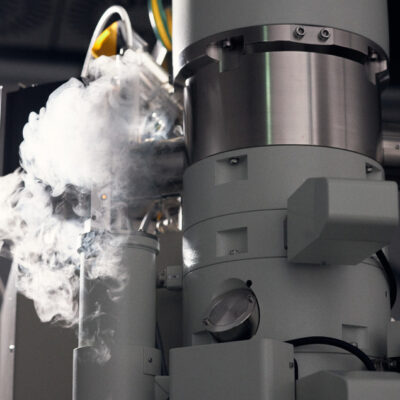
© Patrick Pollmeier/HSBI
Using atomic analyses to recycle plastics efficiently
In the InCamS@BI transfer project, physicists are using high-resolution microscopes to look into the atomic lattice of plastics. Their findings should contribute to boosting circular economy.
Read more »