Enzymes can speed up chemical reactions in a targeted way. Among other uses, they help make chemicals more sustainably. Yet some substances can only be processed at high temperatures — and the delicate proteins often cope poorly with them. Researchers at Bielefeld University have now found a way to use enzymes at 100 degrees Celsius and above: they enclose them in a protective porous structure. This keeps the enzymes functional and allows them to be reused several times. The results have now been published in the journal ‘Angewandte Chemie Novit’.
Key facts at a glance:
- A porous material protects an enzyme from deforming and losing its function at temperatures of 100 degrees Celsius and above.
- The protected enzyme remained functional at 100 degrees Celsius over many reaction cycles.
- The researchers were able to convert chemical starting materials directly in molten form, without organic solvents. This could become relevant in future for producing cosmetics, fragrances and plastics, among other things.
Enzymes play an important role in nature. As biocatalysts, they enable and accelerate chemical reactions in living organisms and keep them under control. These properties also make them interesting for the chemical industry. Compared with many conventional chemical processes, enzyme-catalysed reactions can often be carried out under milder conditions. This saves energy, makes more efficient use of raw materials and avoids waste.
However, enzymes have a weak spot as protein molecules. They need a specific three-dimensional structure to do their job. At high temperatures, this structure can be lost. The enzyme unfolds, much like a ball of wool being pulled apart. It then loses its desired activity as a reaction accelerator.

© Mike-Dennis Müller
© Illustration: Jianing Yang
A polymer cage protects the enzyme
Professor Dr Harald Gröger from the Faculty of Chemistry and his team, together with Professor Dr Andreas Hütten and his team from the Faculty of Physics, investigated how enzymes can be stabilised at high temperatures and used for chemical reactions. Their idea was to embed the enzyme in a protective three-dimensional environment so that it keeps its shape, and with it its activity, even at high temperatures.
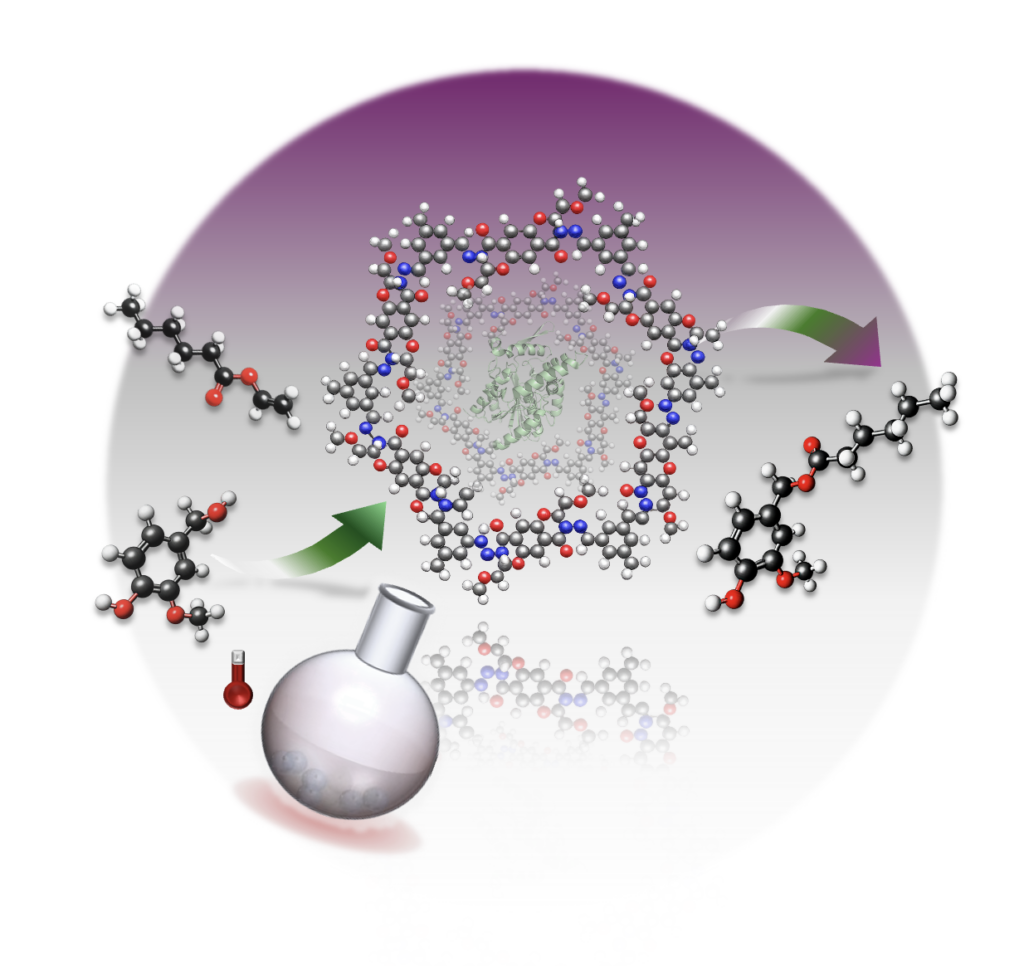
For their experiments, the researchers enclosed the enzyme in a porous structure made of an organic polymer. The pores are large enough for the substances the enzyme needs for the chemical reaction to get in, and for the resulting products to get out again.
At the same time, the structure protects the enzyme from unfolding and thus deforming in the heat. In conventional chemical processes, enzymes are often attached to a surface and are therefore directly exposed to their environment. In the new method, by contrast, the enzyme is protected in a porous cage structure, yet can continue to work and be used several times.
Enzyme protected even at 100 degrees Celsius
For the investigations, the researchers used a lipase. This enzyme is often used for chemical syntheses but is normally sensitive to heat. By embedding it in the porous material structure, the researchers were able to show that the lipase stays active even at high temperatures, and that the porous structure therefore does protect the enzyme from heat. Without this protection, the lipase largely loses its activity.
The enclosed enzyme remained active even at 100 degrees Celsius. At this temperature, it worked about twice as fast as at room temperature. The protected enzyme, which is used as a biocatalyst, also remained effective after repeated use. In an experimental set-up to study its reuse, its performance at 100 degrees Celsius stayed almost unchanged over twelve reaction cycles.
‘The work began with the fundamental research question of which methods can prevent enzymes from unfolding, even at high temperatures and under challenging reaction conditions,’ says Dr Jianing Yang, first author of the study. ‘It turned out that enzymes show the desired properties when they are incorporated into cage compounds in a tailor-made way.’

© Stefan Sättele
Process of interest to the chemical industry
The advantage of high-temperature stability goes beyond the enzyme itself. Some chemical starting materials are solid at room temperature and only melt at temperatures of 100 degrees Celsius or above. For enzymatic reactions, such substances have often had to be mixed with a solvent first, which makes the process more complex.
With the new method, the researchers can instead use the substances directly in molten form. In their experiments, they achieved a reaction at 110 degrees Celsius, among other things. Further tests showed that the approach also works at temperatures of up to 120 degrees Celsius. The reactions required no organic solvents.
This is of interest to the chemical industry. One possible area of use is the production of so-called esters. They are needed for cosmetics, fragrances and plastics, among other things. Many of the starting materials used for this have melting points above 100 degrees Celsius.
© Stefan Sättele
Using enzymes where it was not possible before
‘Our aim was to make biocatalytic processes efficiently usable even where this was previously considered impossible,’ says Professor Dr Harald Gröger, head of the Industrial Organic Chemistry and Biotechnology research group and co-author of the study. ‘We want to push our research consistently towards application and advance the transfer into industrial processes.’
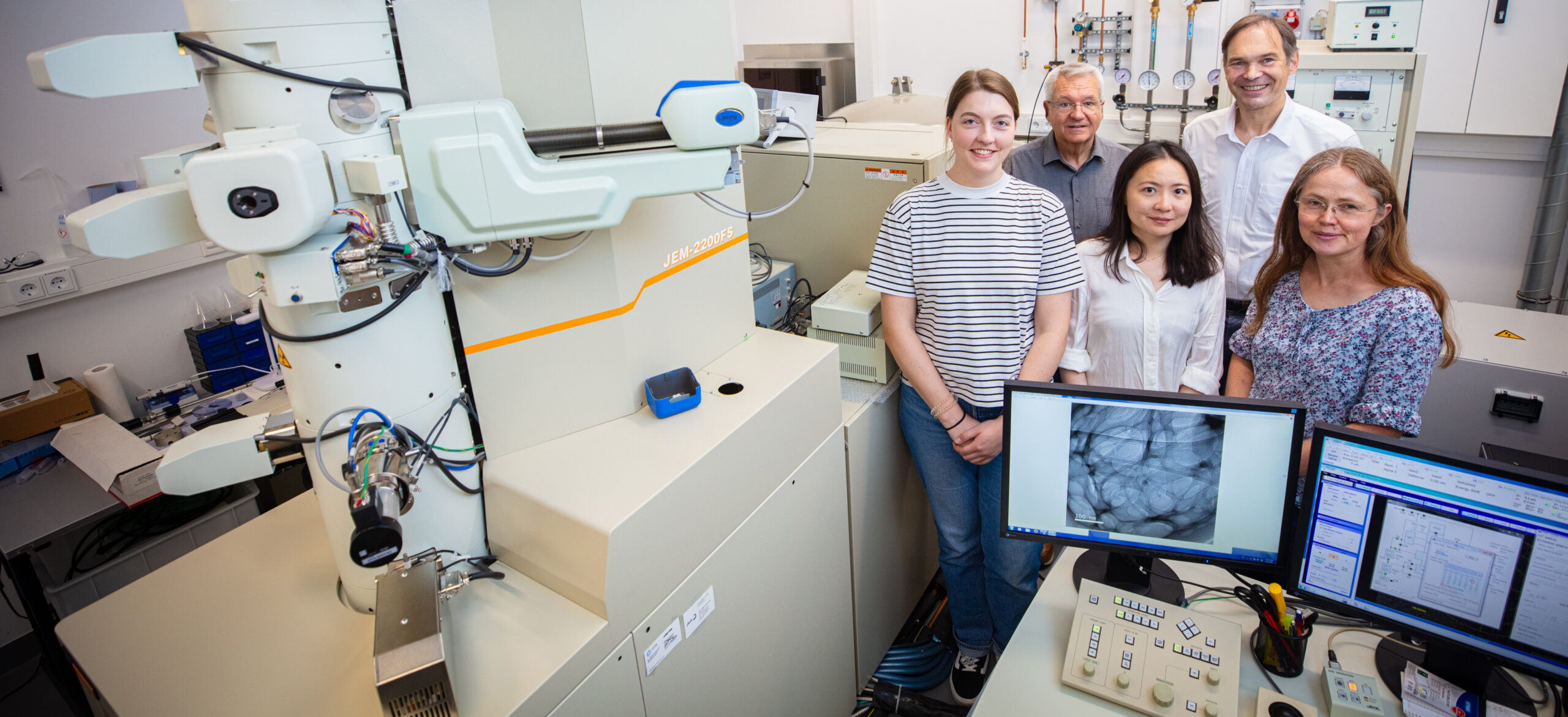
Professor Dr Andreas Hütten, senior professor of physics in Bielefeld and co-author of the study, investigated with his team, among other things, the structure of the material and how the enzyme is enclosed within it. Electron microscopy techniques were also used for this.
‘We examined the structure of the material with a high-resolution transmission electron microscope and gained insights into the interior of the porous polymer structure,’ says Hütten. ‘That was a particular challenge because the material is not regularly structured like a crystal.’ The investigations were important for understanding how the porous structure is built and how the enzyme is enclosed.
One of the central challenges we face today is the change in raw materials that lies ahead of us, and not only shaping the change in raw materials itself, but of course also linking this to efficient and sustainable synthesis processes that ultimately lead to less waste and at the same time offer the possibility to produce chemicals as cost-effectively and economically as possible.
Producing chemicals sustainably: Biocatalysis at over 100 °C
For the chemical industry, it is a crucial aspect to increasingly produce with minimal waste in the future, and with the help of our technology, it is possible to carry out transformations completely without solvents, for which solvents would typically be required today.
Biocatalysts are particularly attractive to us because they are sustainable, highly selective and can be produced under mild conditions, the enzymes. In comparison, for example, to metal catalysts, which are often environmentally harmful and require the use of large amounts of solvents for disposal and production. These problems simply do not exist in the field of biocatalysis.
It is also a good example of how improved economy goes hand in hand with increased sustainability.
As reaction accelerators, we use proteins, tools from nature that are present in every cell and are able to speed up reactions. However, proteins generally have the disadvantage that they deactivate relatively quickly.
Deactivation can be compared to a ball of yarn or wool, which unfolds and thus is no longer available as a reaction accelerator. The idea behind our concept was that through encapsulation, so to speak, by placing this ball of yarn into a cage, we can prevent unfolding and thus ultimately enable reactions to be carried out at temperatures at which the ball of yarn, the protein, would typically unfold.
Accordingly, we are now able to carry out such transformations at temperatures above 100 degrees.
This technology that we have developed has also been patented, with the goal of commercializing it and applying it together with industry partners for the synthesis of technical products.
The applications are primarily focused on the production of cosmetic esters and flavor compounds. These classes of substances play a major role in industry. The market volume is also very high. As of 2024, it already amounts to 3.75 billion euros, with a growth potential of around 5%.
A decisive criterion for this technology development was also the high level of interdisciplinarity. Two fields come together here, so to speak, that are often viewed very separately in chemistry: on the one hand organic synthesis, and on the other hand biotechnology.
This also corresponds to the characteristic trait of Bielefeld University, namely the interdisciplinary conduct of research through the combination of different scientific disciplines, in our case biotechnology, biology, organic synthesis and process engineering.
Further research for industrial application
The collaboration also shows how a fundamental scientific question can lead to a possible industrial application. The researchers have since held talks with companies from various product areas. The aim is to develop the method further and extend it to other enzymes and industrial processes. More studies are still needed, among other things on the long-term stability of the biocatalysts and on transferring the method to an industrial scale.
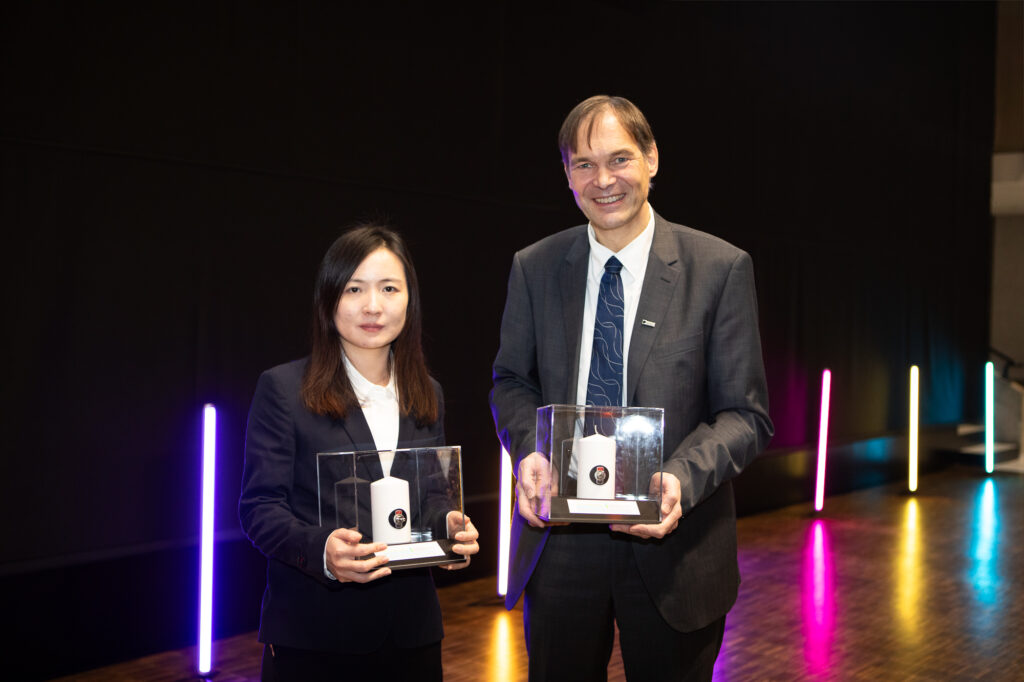
The research was awarded the Jörg Schwarzbich Inventor Award 2025 as early as the start of 2026. The prize, worth 40,000 euros, is awarded by the Universitätsgesellschaft Bielefeld and Bielefeld University and recognises scientific inventions with high potential for innovation and application.Anwendungspotenzial.
Original publication

Jianing Yang, Inga Ennen, Judith Bünte, Andreas Hütten, Harald Gröger: Efficient Lipase-Catalyzed Synthesis at ≥100°C Through Biocatalyst Entrapment in a Porous Organic Polymer. Angewandte Chemie Novit, https://doi.org/10.1002/anov.70023, published on 21 Juli 2026