Plants of the same species can differ considerably in their chemical composition, affecting their smell, taste, and even toxicity. A new study shows that the term “chemotype” has so far not been used consistently. Researchers at Bielefeld University propose clear criteria for describing chemical differences within a plant species in a precise and unambiguous way.
Key facts at a glance:
- Plants of the same species can have different chemical profiles and therefore belong to different chemotypes.
- To classify a chemotype unambiguously, researchers should specify which plant organ and which chemical family they have examined.
- Clear definitions improve the comparability of research findings and are also relevant to medicinal plants, agriculture, and plant protection.
“Until recently, plants of the same species were assigned to different chemotypes without precisely defining, which organ and which chemical family was investigated,” says Professor Dr. Caroline Müller, lead author of the study. “With our systematic approach, we are establishing clearer criteria for defining what exactly constitutes a chemotype.”
What Lies Within a Plant?
A chemotype describes plants within a species that differ in specific chemical compounds. These include terpenoids and alkaloids, for example – chemical compounds that plants use, among other things, to influence herbivores or pathogens.
Differences between chemotypes are largely genetically determined. Environmental conditions can, however, further modify the precise chemical composition. The plant organ examined also matters: leaves, flowers, and roots can have different chemical profiles.
Using common tansy (Tanacetum vulgare), the researchers from the DFG-funded Research Unit FOR 3000 demonstrate how strongly the classification of a chemotype can depend on which chemical family is examined. Without consistent criteria, findings from different studies can therefore only be compared to a limited extent.
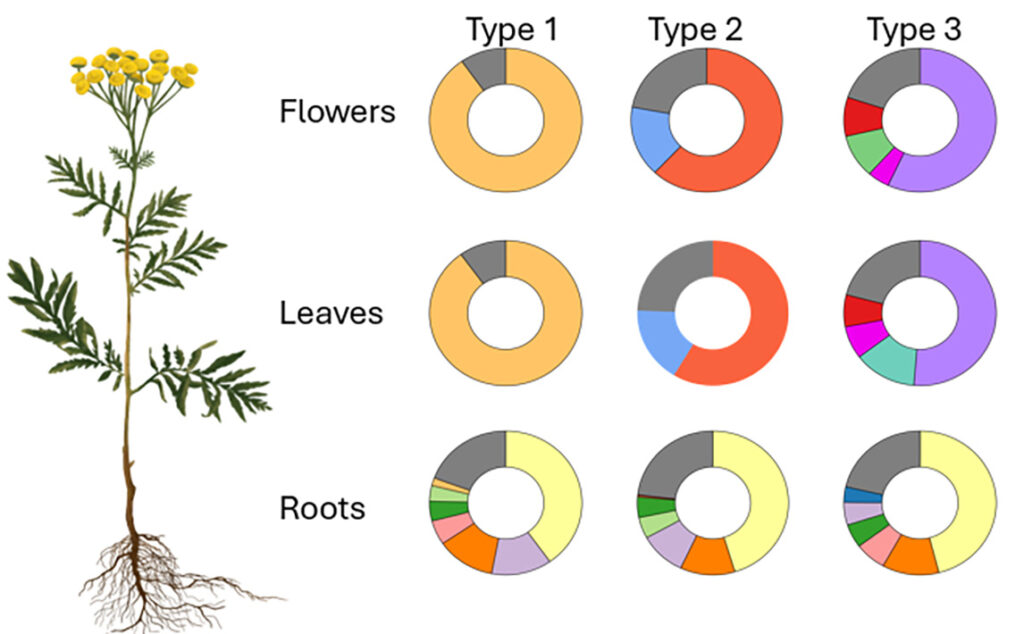
© Caroline Müller
Relevance for Medicinal Plants and Agriculture
These differences also matter for practical applications. Tansy was formerly used as a “worm herb” to treat intestinal worms. Depending on the chemotype, however, the plant can vary in toxicity. Another example is cannabis: Different chemotypes can differ considerably in their THC (Tetrahydrocannabinol) content and, consequently, in their effects.
Knowledge about chemotypes may also be relevant to agriculture. Their chemical properties influence how attractive plants are to herbivores and pathogens. In the long term, this knowledge could help researchers to select plants more specifically and increase their resilience to environmental conditions.
Research at Bielefeld University also addresses individual differences within plant species as part of the university’s strategic focus area InChangE: “Individualization in Changing Environments.”

© Bielefeld University