One is a literary scholar, the other a cognitive scientist. In their respective works, they both engage with texts and language, and they also continuously research and give lectures on the topic of gender within this context. Professor Dr Heide Volkening and Professor Dr Evelyn Ferstl have one more thing in common: their academic work is strongly interdisciplinary. At the invitation of the Faculty of Linguistics and Literary Studies, they took up the Gender Guest Professorships for the 2025/26 academic year at Bielefeld University in the summer semester.
Literature as a particularly suitable form of discourse for the topic of gender
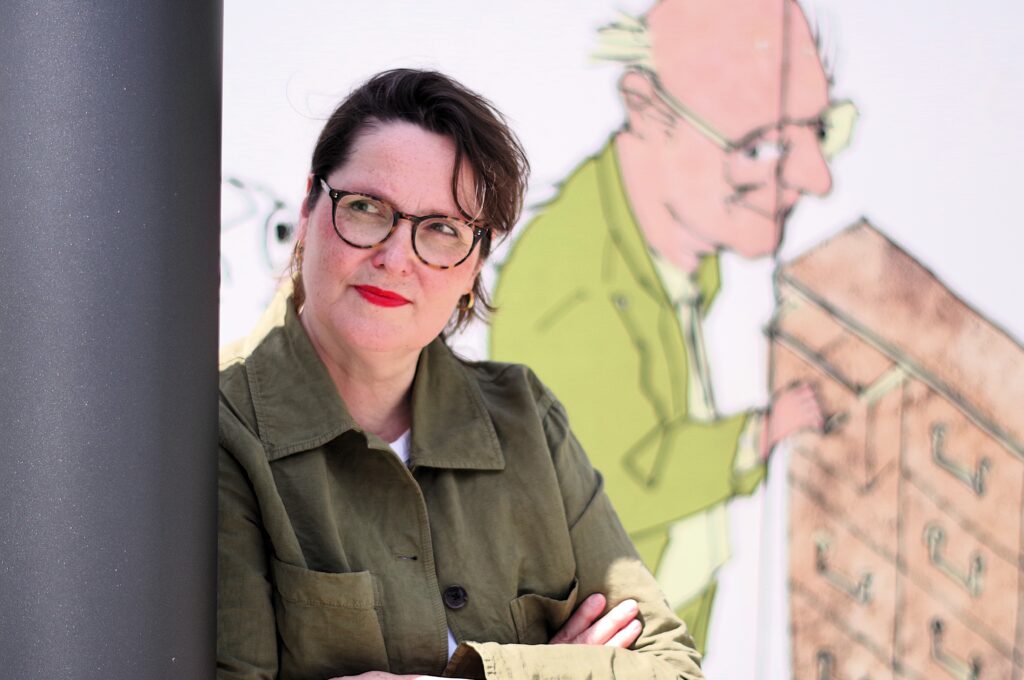
Gender studies has undergone a transformation within literary studies. In its early days, the main focus was on revisiting the literary historiography, which only, or mainly, deemed texts by male authors relevant. With the discovery and inclusion of female authors, this focus shifted towards a more comprehensive literary history. ‘By the 1990s at the latest, the perspective had broadened, and since then there has been increasing research into literary constructions of masculinity and femininity as well as the possibilities and codings of both non-binary and binary gender conceptions,’ says Professor Dr Heide Volkening, who teaches literary studies and gender studies at the University of Greifswald. By now, gender studies are established in literary studies and, like other theories and approaches, belong to the fixed repertoire of humanities study.
© Elena Berz
In her research, Volkening herself is repeatedly drawn to venturing beyond the confines of her own field by examining interdisciplinary connections. For example, for her doctoral dissertation the literary scholar dealt with female authors’ autobiographies and ghostwriting – a topic that linked literary theory, gender studies and copyright law. In her habilitation and later works on the topic of ‘work’, she also touched on ergonomics and sociology as well as Marxism. Volkening has researched ‘Working Girls’, that is, working young women in the literature of the Weimar Republic. ‘In all these contexts, literature seems to manifest for me again and again as a discursive entity that, better than others, can take up and vary in themes such as gender, reframe them and shift them in artistic, experimental or also affectively energising ways.’
Alongside the linguist Theresa Heyd, Heide Volkening is currently writing the book ‘Doing Cringe’ in which they connect contemporary cultural and literary phenomena of shame-pleasure with discursive digital practices. ‘Our observation is that cringe describes a specific sensitivity of the present, through which cultural change and breaches of social norms are met. Similar to shame, individual feelings, social ideas of normality, aesthetic condensations and everyday communicative practices converge here and form a very interesting constellation within one still needs to differentiate,’ says Volkening.
As a Gender Guest Professor, she displayed how shame is linked to constructions of masculinity among other things. Volkening is also involved in the collaborative project ‘Inclusive Excellence in Medicine’, working on gender as a category of knowledge in medical discourses. The interdisciplinary project, funded by the Bundesministerium für Forschung, Technologie und Raumfahrt, aims to strengthen and embed approaches from gender studies in medical research in a sustainable way. ‘From the perspective of the humanities, alongside the natural-science focus on operationalising gender difference, we offer a kind of critical reflection that makes the historical, cultural and semantic conditions of these differentiations transparent. Looking at the history of medicine, the example of hysteria immediately highlights how literary constructions of femininity and medical pathologisation complement one another.’
Language can contribute to equality and diversity
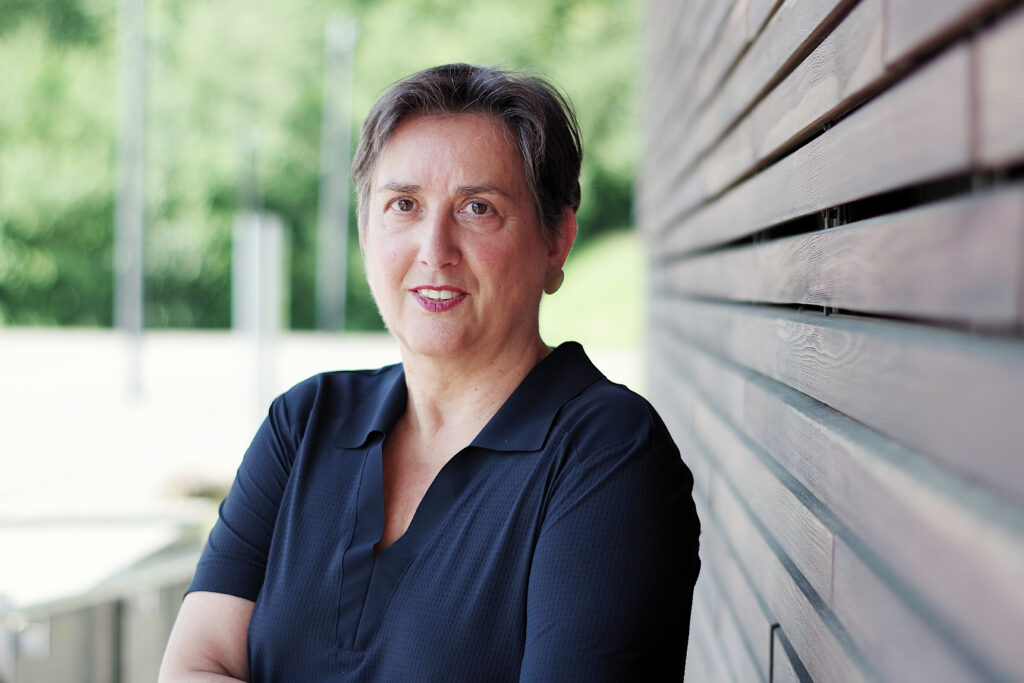
Professor Dr Evelyn Ferstl is Professor of Cognitive Science and Gender Studies at the University of Freiburg and an expert in gender-inclusive language. In the somewhat heated social debate about gender-inclusive language, she argues for a factual discussion – and her research helps create a basis for debate grounded in scientific findings. She has just completed, a multi-year project on gender-inclusive language funded by the Deutsche Forschungsgemeinschaft alongside other scholars. As a guest professor at Bielefeld University, Ferstl presented and discussed the experimental studies from the research project in a lecture for specialist colleagues from the Faculty of Linguistics and Literary Studies.
The professor, who studied mathematics and cognitive science and completed her habilitation in cognitive neuroscience, argues in favour of gender-inclusive language from a scholarly perspective. It not only directly addresses people who identify as non-binary, but includes everyone through the inclusive reading. In German, the generic masculine form tends to be used which has been highlighted until recently through German phrasings such as ‘Ask your doctor or pharmacist!’ (‘Fragen Sie ihren Arzt oder Apotheker!’). That said, ‘the fact that the generic masculine – even if it is intended to be gender-neutral – triggers a male bias and typically evokes the idea of a male person which has since been demonstrated throughout numerous experiments.’ Studies have also shown that women feel more directly addressed by gender-inclusive language: studies analysing online application portals, for example, were able to show that women click on adverts more often when they are given gender-inclusive titles. ‘Language can therefore definitely contribute to equality and diversity, says Forstl.’
© Elena Berz
Ferstl is not able come up with quite as many studies in order to object to the critics’ argument that gender-inclusive language makes language acquisition more difficult: ‘Surprisingly, there is still relatively little research on this.’ That said, surveys in which readers rated texts with or without the gender asterisk exist, for example. The results highlight that only texts with combined phrases in the singular person (for example, ‘der*die Lehrer*in’) are classified as harder to understand, not texts with a simple construction in the plural form (‘die Lehrer*innen’), however. ‘In addition, in a recently published study we found that students of German – who speak Dutch as their first language – were able to read and understand texts with the gender asterisk just as well as texts including masculine forms.’ In another lecture during her time at Bielefeld University, Ferstl gave scientifically grounded answers to ten questions about gender-inclusive language.
Evelyn Ferstl’s research is not limited to gender topics. ‘My academic path is shaped by interdisciplinary work,’ she emphasises. ‘I connect cognitive science with gender research, linguistics with psychology. Specifically, I investigate the comprehension of language in all its facets.’ Here, the utterance or the text itself is only one part of the whole. The prior knowledge of the communication partners, their intentions, the genre of a text or the situation in which a conversation takes place are just as important. ‘I am particularly interested in the point of intersection with emotion, for example in jokes or irony, and – of course – gender studies.’ It is also evident in her current project, which was funded by the Leibniz-Gemeinschaft under the ‘Cooperative Excellence’ funding line and enables collaboration with the Institut für Deutsche Sprache (IDS) and the Deutsches Institut für Wirtschaftsforschung (DIW), that Ferstl values building bridges between different academic cultures in her research.
‘We are investigating whether linguistic frequencies can be explained by gender stereotypes or if they simply occur within society.’ For example, the word ‘Ärztin’ (female physician) is significantly less common than ‘Arzt’ (male physician). ‘Is that because there are still fewer female doctors, or because the stereotype of ‘Herr Doktor’ stubbornly persists?’ To get to the bottom of this and other questions, the researchers are collecting stereotypes for one hundred human descriptors in a large representative survey. ‘We look forward to the data in the second half of the year. In addition, we are using experimental paradigms to verify the findings through other methods.’
Gender Guest Professorship at Bielefeld University

The Gender Guest Professorship is a university-wide established rotating professorship. Through it, Bielefeld University aims to structurally strengthen the respective academic disciplines in both research and teaching and make gender studies more visible. Since 2012, visiting professors have been addressing gender studies in their respective disciplines, thus raising awareness for the topic by addressing both the specialised community and students. While doing so, they also strengthen the visibility of women within academics.